Technical Specifications
Overview
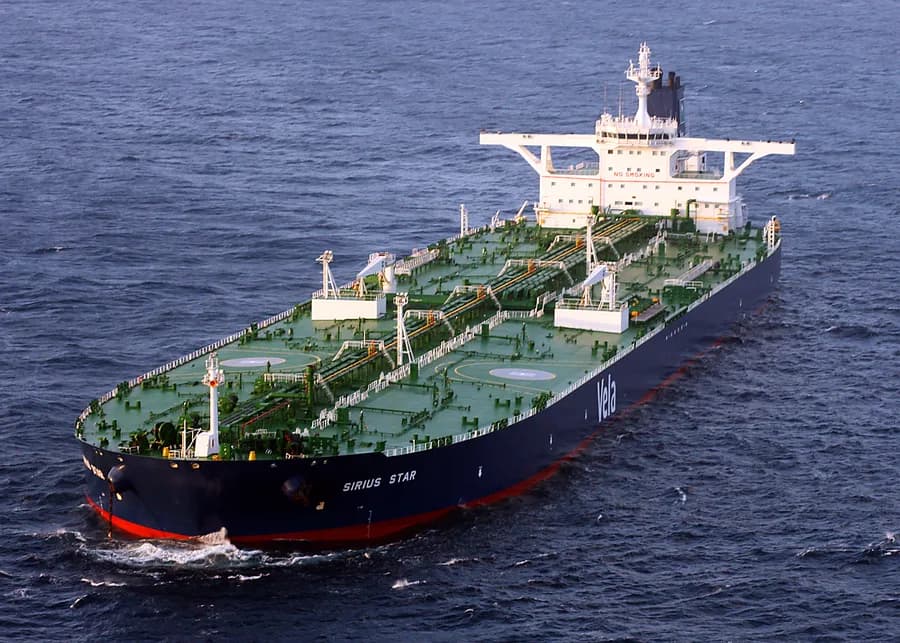
MV Manifa (formerly MV Sirius Star) is an oil tanker formally owned and operated by Vela International Marine. With a length overall of 330 m (1,080 ft) and a capacity of 2.2 million barrels (350,000 m3) of crude oil, she is classified as a very large crude carrier or VLCC. Vela is based in the United Arab Emirates and is a subsidiary of the Saudi Arabian state oil company Saudi Aramco. Sirius Star is one of Vela's 24 tankers, of which 19 are VLCCs. Since her launch, the ship has been registered in Monrovia under the Liberian flag of convenience. She has since been reflagged to Saudi Arabia. Sirius Star was built by the South Korean company Daewoo Shipbuilding & Marine Engineering. Her construction began in October 2007 and she was launched by Huda Al-Ghoson in late March 2008. She received international attention when she was hijacked by Somali pirates (allegedly under the orders of piracy kingpin Mohamed Abdi Hassan) on 15 November 2008, becoming the largest ship ever captured by pirates. She was en route from Saudi Arabia to the United States by way of the Cape of Good Hope. At the time of the attack, she was about 450 nautical miles (830 km) southeast of the coast of Kenya, carrying 25 crewmen and her tanks fully loaded with oil. She was estimated to be worth approximately US$150 million, with her cargo worth at least US$100 million.
Live Tracking
Most time stopped at Port of Singapore — 23 h across 1 stay.
Derived from the AIS track — runs of near-zero speed (anchored, moored or drifting) snapped to the nearest port. Builds up as we observe the vessel.
Intelligence
How a hull like this loses value with age (today's market). The dot marks this ship at 18 yrs.
Estimate from $/dwt of similar-size, similar-age ships sold in the last 24 months. Indicative, not a certified valuation.
Open the full multi-model valuationThis ship has no verified emissions report. We estimate a band A from its segment, size and age (83% confidence).
Estimate, not a reported figure. Within one band 95% of the time on reported peers.
AIS-derived from our live feed.
Operational Status
The latest broadcast is too stale or lacks the speed / status to classify.
Read from the single most-recent AIS broadcast we hold for this hull — we keep no position history, so this is a point-in-time posture, not a dwell inference. Derived in-house from our own AIS feed; weight it by the broadcast age above.
Composite Risk
Multiple adverse factors, or a hard ship-specific signal, lift this hull above the fleet norm.
A coverage-weighted blend of the 3 components we could read for this hull — the weights renormalise over only the components present, so a thin read is never inflated and a hull is never credited a “safe 0” for a signal it has no row for. Higher means riskier. Derived in-house from government-open port-State-control, flag, sanctions and our own vessel data; weight it by the coverage above.
Estimated
Tanker · summer draught 10.9 m · 192.4 t per cm immersion
Estimate only — modelled from deadweight (deadweight regression) using a first-principles hydrostatic model, not measured hydrostatic tables. The design draught it is anchored to is unreliable across the fleet.
density DWT/GT=1.97 is consistent with declared tanker
Declared type is consistent with the class implied by the vessel’s size signals. Inferred via our shared size-based classifier.
Transparency
Behavioural flags raised against this vessel — each shown with the raw evidence behind it. Derived in-house from data we are entitled to publish; informational, not a determination of wrongdoing.
Stopped transmitting relative to the live feed front
Method: gap measured vs the live feed's own max timestamp, not wall-clock. Source: TheMaritime aisstream.io ingest (ais_positions).
Signals are a current-state view: a flag clears once the vessel stops tripping its detector. These are screening indicators, not a substitute for your own due diligence.
Commercial

Visual Archive
Explore More