Technical Specifications
Overview
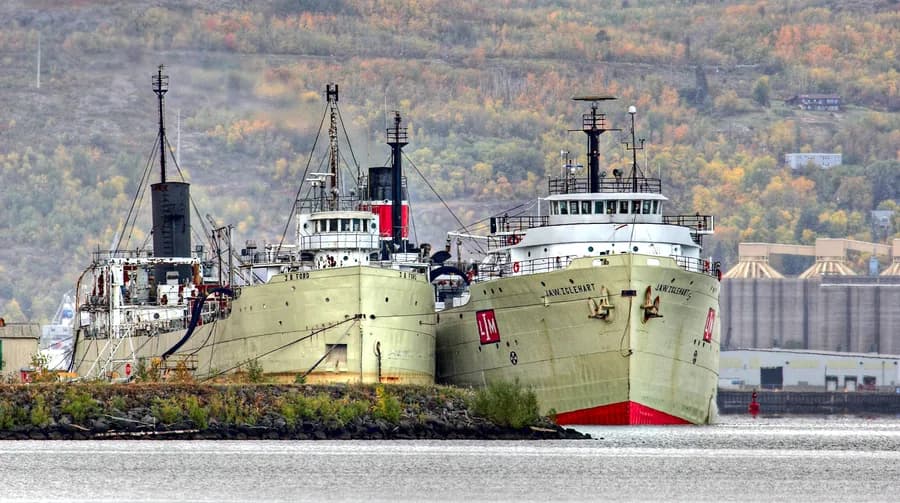
J. B. Ford was a steamship bulk freighter that saw service for 112 years on the Great Lakes of the United States and Canada. The ship was launched at Lorain, Ohio on 12 December 1903 as Edwin F. Holmes. The freighter was named in honor of Edwin Francis Holmes, an investor in the Hawgood & Avery Transit Co. and a director of the Hawgood & Avery Fleet in 1904. Edwin F. Holmes sailed in the Commonwealth Steamship Fleet until 1911 when she was transferred to the Acme Transit Fleet (another of the Hawgood fleets). At the time of its scrapping was the oldest intact lake freighter still afloat. The ship was 440 feet (130 m) long with a 50-foot (15 m) beam, and a depth of 28 feet (8.5 m). It was powered by a 1,500-horsepower (1,100 kW) triple-expansion steam engine, fed by two coal-fired Scotch marine boilers. J. B. Ford had 12 hatches feeding into 4 cargo compartments. Although J. B. Ford had not seen powered service since 15 November 1985, it served as a stationary cement storage and transfer vessel in South Chicago, Chicago, from 1987 until 2001. The vessel was towed to Superior, Wisconsin to serve in the same capacity. The vessel continued in this duty until 2006 when J. A. W. Iglehart, former fleet mate of J. B. Ford, was retired from service and took over the duties at Superior. J. B. Ford was moved to a storage dock awaiting orders to scrap the vessel. The scrapping of E. M.
Composite Risk
Multiple adverse factors, or a hard ship-specific signal, lift this hull above the fleet norm.
A coverage-weighted blend of the single component we could read for this hull; the weights renormalise over only the components present, so a thin read is never inflated and a hull is never credited a “safe 0” for a signal it has no row for. This headline is flagged low-confidence (a thin or structural-only read) and should not be treated as a verdict. Higher means riskier. Derived in-house from government-open port-State-control, flag, sanctions and our own vessel data; weight it by the coverage above.
Commercial
Price it in the Route Planner between any two commercial ports: ballast and laden legs, two fuels at live bunker prices, port and canal costs, the weather on the way, and the TCE set against the market.

Visual Archive