Technical Specifications
Overview
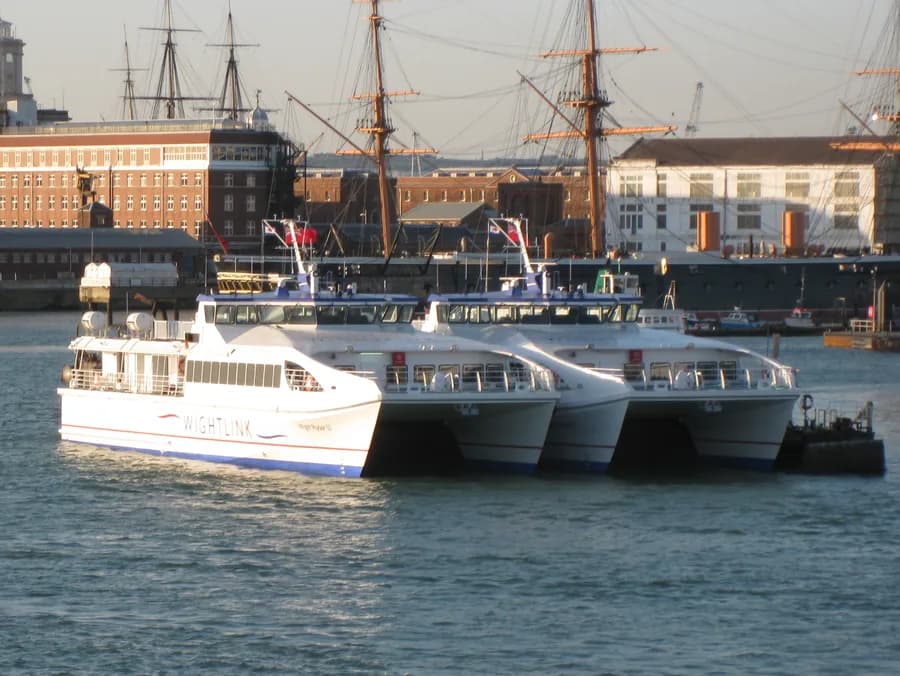
HSC Wight Ryder I is one of two high-speed passenger catamarans operated by Wightlink on the Ryde to Portsmouth ferry route. Both vessels left their construction site in the Philippines in June 2009, and began service in September 2009. In preparation for their arrival, berth improvements at Portsmouth Harbour and Ryde Pier were carried out. Following the introduction of the Wight Ryders into service, the existing vessels, FastCat Ryde and FastCat Shanklin were phased out, and eventually sold to new owners in Bristol. Unlike the older catamarans, the new vessels do not feature yellow and white "FastCat" branding, but are painted in a similar livery to Wightlink's larger car ferries. They include an open-air upper deck whereas the previous catamarans were fully enclosed. On introduction, the vessels were criticised for being too slow and too small, with a seating capacity reduced from 294 to 260. Wightlink stated that a new timetable would be introduced offering more services during the day to ensure that there would be sufficient places to meet demand. The maximum speed is 26 knots compared to 34 knots for the earlier vessels, but as significant time is spent in the speed-limited region round Portsmouth Harbour, only a couple of minutes are lost, and fuel consumption is significantly less.
Composite Risk
Some elevated factors (typically age or a lower-graded flag), but no acute ship-specific flag.
A coverage-weighted blend of the single component we could read for this hull; the weights renormalise over only the components present, so a thin read is never inflated and a hull is never credited a “safe 0” for a signal it has no row for. This headline is flagged low-confidence (a thin or structural-only read) and should not be treated as a verdict. Higher means riskier. Derived in-house from government-open port-State-control, flag, sanctions and our own vessel data; weight it by the coverage above.
Commercial
Price it in the Route Planner between any two commercial ports: ballast and laden legs, two fuels at live bunker prices, port and canal costs, the weather on the way, and the TCE set against the market.

Visual Archive