Technical Specifications
Overview
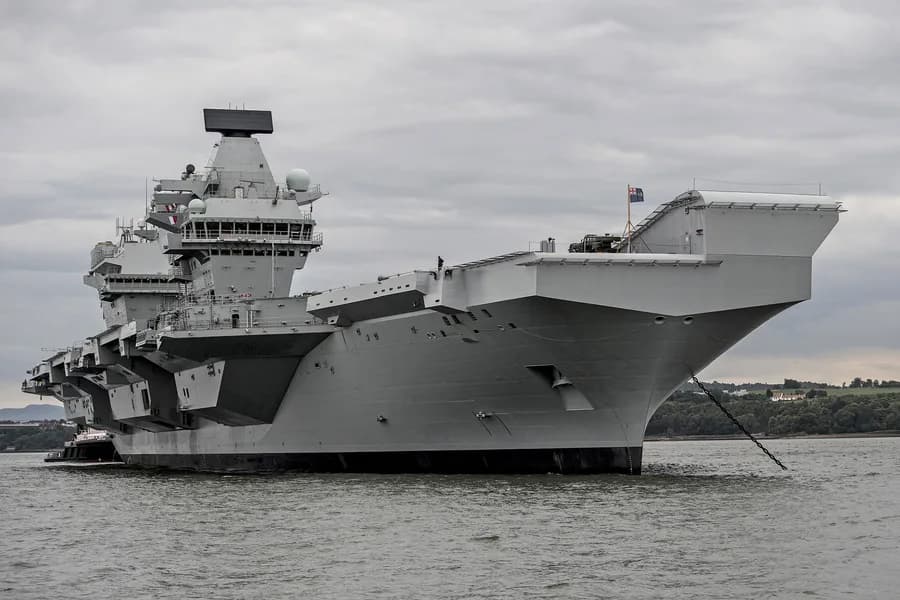
HMS Queen Elizabeth is the lead ship of the Queen Elizabeth class of aircraft carriers built for the Royal Navy. Capable of carrying 60 aircraft including fixed wing, rotary wing and autonomous vehicles, she is named in honour of the first HMS Queen Elizabeth, a World War I era super-dreadnought, which in turn was named after Queen Elizabeth I. The carrier Queen Elizabeth carries her namesake ship's honours, as well as her Tudor rose-adorned crest and motto. Queen Elizabeth commenced her sea trials in June 2017, was commissioned on 7 December 2017 and entered service in 2020. Her first seagoing commanding officer was Commodore Jerry Kyd who was appointed in 2014 but did not take command until May 2016, having previously commanded the carriers Ark Royal and Illustrious. The ship is designed to operate V/STOL aircraft. The air wing will typically consist of F-35B Lightning II multirole fighters and Merlin helicopters for airborne early warning and anti-submarine warfare. The design emphasises flexibility, with accommodation for 250 Royal Marines and the ability to support them with attack helicopters and large troop transports such as Chinooks. She is based at HMNB Portsmouth. Queen Elizabeth will deploy as the central part of a UK Carrier Strike Group with escorts and support ships in order to deliver carrier-enabled power projection.
Composite Risk
No strong adverse signal on the components we could read for this hull.
A coverage-weighted blend of the single component we could read for this hull; the weights renormalise over only the components present, so a thin read is never inflated and a hull is never credited a “safe 0” for a signal it has no row for. This headline is flagged low-confidence (a thin or structural-only read) and should not be treated as a verdict. Higher means riskier. Derived in-house from government-open port-State-control, flag, sanctions and our own vessel data; weight it by the coverage above.
Commercial
Price it in the Route Planner between any two commercial ports: ballast and laden legs, two fuels at live bunker prices, port and canal costs, the weather on the way, and the TCE set against the market.

Visual Archive