Technical Specifications
Overview
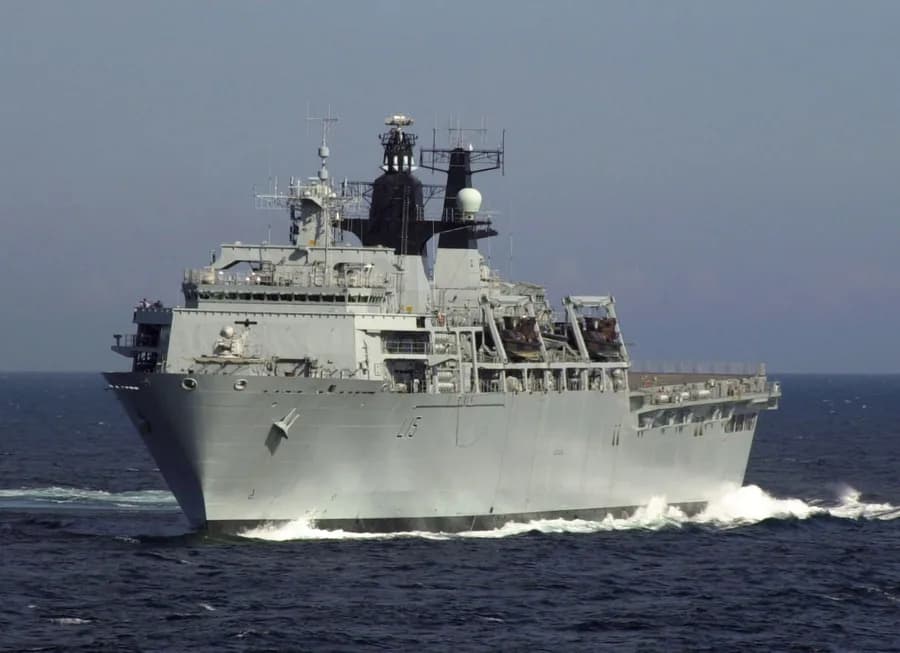
HMS Bulwark is the second unit of the Albion-class assault ships originally built for the Royal Navy. She was one of the United Kingdom's two landing platform docks designed to put Royal Marines ashore by air and by sea. She was retired as of March 2025. Although launched in 2001, delays caused the delivery date to be put back, and the ship entered service on 28 April 2005. Together with Albion, and other amphibious ships, she has provided a larger and more effective amphibious capability than the previous Fearless-class vessels. Between October 2011 and June 2015 she was the fleet flagship of the Royal Navy. She has been in extended upkeep since 2020. The ship is designed to send large numbers of troops and vehicles to shore as quickly as possible. Bulwark has supported a permanently embarked Royal Marines landing craft unit, 4 Assault Squadron Royal Marines. The rear of Bulwark opens and floods a compartment, allowing the boats inside to be launched. The 64-metre (210 ft) flight deck is able to take two Sea King HC4 or Merlin medium-lift helicopters and stow a third. The deck can also support two Chinook heavy-lift helicopters, one down the side of the flight deck and one at the rear of the flight deck. Although the Albion design does not have a hangar, the ship has sufficient equipment to support helicopter operations.
Composite Risk
Multiple adverse factors, or a hard ship-specific signal, lift this hull above the fleet norm.
A coverage-weighted blend of the single component we could read for this hull; the weights renormalise over only the components present, so a thin read is never inflated and a hull is never credited a “safe 0” for a signal it has no row for. This headline is flagged low-confidence (a thin or structural-only read) and should not be treated as a verdict. Higher means riskier. Derived in-house from government-open port-State-control, flag, sanctions and our own vessel data; weight it by the coverage above.
Commercial
Price it in the Route Planner between any two commercial ports: ballast and laden legs, two fuels at live bunker prices, port and canal costs, the weather on the way, and the TCE set against the market.

Visual Archive