Technical Specifications
Overview
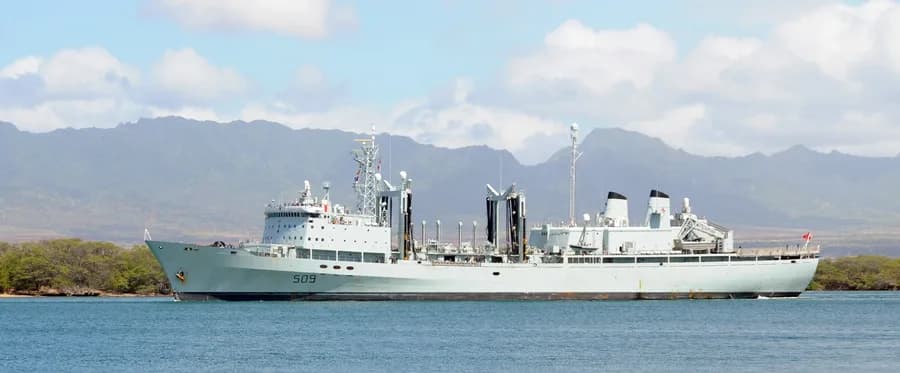
HMCS Protecteur (AOR 509) was the lead ship of the Protecteur-class replenishment oilers in service with the Royal Canadian Navy. She was part of Maritime Forces Pacific (MARPAC), homeported at CFB Esquimalt, British Columbia. Built by Saint John Shipbuilding and Dry Docks in Saint John, New Brunswick, she was commissioned on 30 August 1969. She was the first Canadian naval unit to carry the name Protecteur; however, there have been several units, including a base, named HMCS Protector. Mostly known for her humanitarian efforts, Protecteur had also served in times of war including Operation Friction and Operation Apollo in the Persian Gulf region, multi-national naval exercises, and as part of the INTERFET in East Timor. Operation Apollo was the largest deployment of the Royal Canadian Navy since the Korean War. In six months Protecteur logged over 50,000 nautical miles (93,000 km; 58,000 mi), delivering over 150,000 barrels (~20,000 t) of fuel and 390 pallets of dry goods to deployed coalition ships. Protecteur, as well as her sister ship Preserver, were scheduled to be paid off in 2017, however, damage due to an engine fire aboard the ship in 2014 forced Protecteur to be paid off prematurely. Protecteur was decommissioned at a farewell ceremony on 14 May 2015.
Composite Risk
Multiple adverse factors, or a hard ship-specific signal, lift this hull above the fleet norm.
A coverage-weighted blend of the single component we could read for this hull; the weights renormalise over only the components present, so a thin read is never inflated and a hull is never credited a “safe 0” for a signal it has no row for. This headline is flagged low-confidence (a thin or structural-only read) and should not be treated as a verdict. Higher means riskier. Derived in-house from government-open port-State-control, flag, sanctions and our own vessel data; weight it by the coverage above.
Commercial
Price it in the Route Planner between any two commercial ports: ballast and laden legs, two fuels at live bunker prices, port and canal costs, the weather on the way, and the TCE set against the market.

Visual Archive