Technical Specifications
Overview
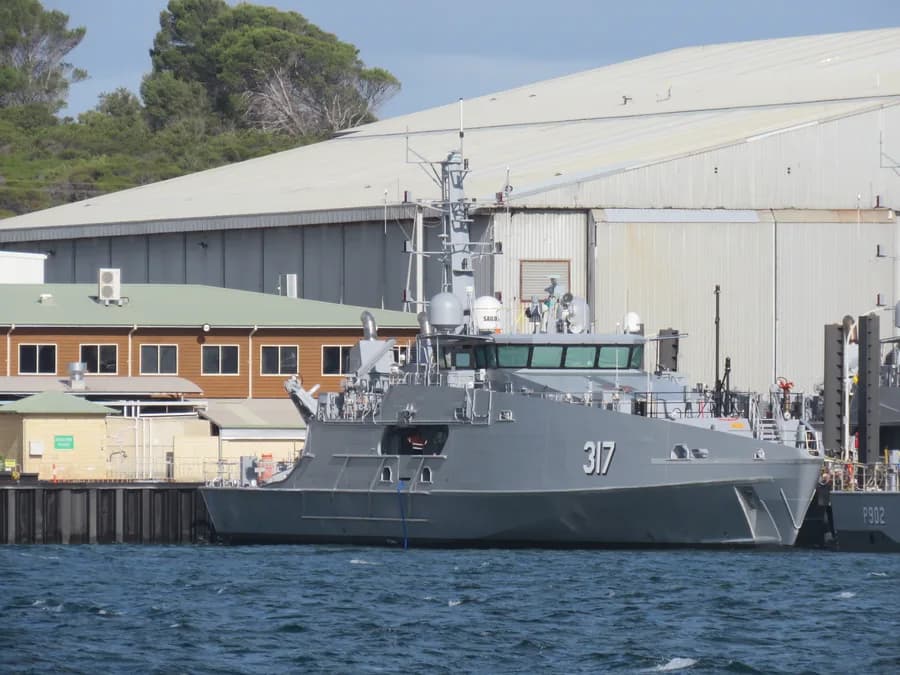
HMAS Cape Capricorn, formerly the Australian Defence Vessel (ADV) Cape Capricorn, named after Cape Capricorn in Queensland, is an evolved Cape-class patrol boat of the Royal Australian Navy (RAN). The ship is the fourth of ten evolved Cape-class patrol boats to be delivered to the Royal Australian Navy. Prior to Cape Capricorn, the RAN already operated the Cape-class patrol boats Cape Fourcroy and Cape Inscription as well as the evolved Cape-class patrol boats Cape Otway, Cape Peron and Cape Naturaliste. The ship was built by Austal in Henderson, Western Australia, accepted on 13 February 2023 and based at HMAS Coonawarra in Darwin, Northern Territory. Cape Capricorn was officially welcomed in Darwin in June 2023, alongside her sister ship Cape Naturaliste, becoming the first evolved Cape-class patrol boats to be based there. The patrol boat's primary duty lies in fisheries protection, immigration, customs and drug law enforcement operations. The ship is one of the original six evolved Cape-class patrol boats the RAN ordered in April 2020 to replace the Armidale-class patrol boats in this role, at a projected cost of A$324 million. This order was subsequently expanded by another two boats in April 2022, at an additional projected cost of $124 million. In November 2023, the RAN ordered a further two evolved Cape-class patrols, at a cost of A$157.1 million.
Composite Risk
No strong adverse signal on the components we could read for this hull.
A coverage-weighted blend of the single component we could read for this hull; the weights renormalise over only the components present, so a thin read is never inflated and a hull is never credited a “safe 0” for a signal it has no row for. This headline is flagged low-confidence (a thin or structural-only read) and should not be treated as a verdict. Higher means riskier. Derived in-house from government-open port-State-control, flag, sanctions and our own vessel data; weight it by the coverage above.
Commercial
Price it in the Route Planner between any two commercial ports: ballast and laden legs, two fuels at live bunker prices, port and canal costs, the weather on the way, and the TCE set against the market.

Visual Archive