Technical Specifications
Live Tracking
Most time stopped at Superior — 26 h across 3 stays.
Derived from the AIS track — runs of near-zero speed (anchored, moored or drifting) snapped to the nearest port. Builds up as we observe the vessel.
Intelligence
This ship has no verified emissions report. We estimate a band E from its segment, size and age (83% confidence).
Estimate, not a reported figure. Within one band 95% of the time on reported peers.
AIS-derived from our live feed.
Compliance
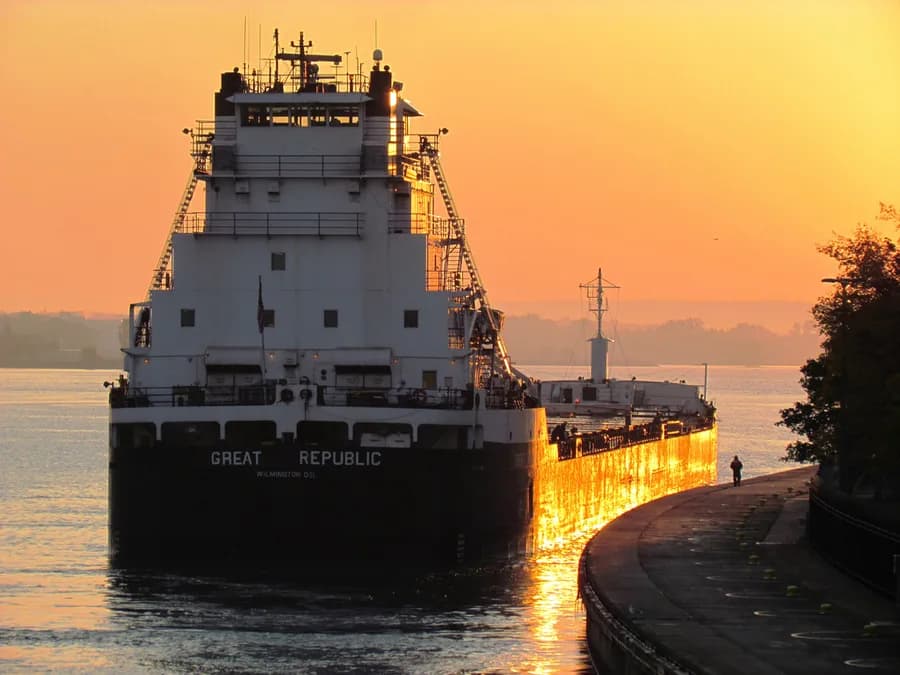
On 23 October 2023, the bulk carrier "GREAT REPUBLIC" reported having experienced a close quarters situation with a fleet of fishing vessels in the Detroit River, ON.
On 14 September 2008, while the bulk carrier "ALGORAIL" was being assisted by tug "WYOMING" downbound in the Rouge River, Detroit, the bulk carrier scraped against the Short Cut Bridge and touched the "AMERICAN REPUBLIC". USCG investigating.
Recorded marine occurrences naming this vessel.
Operational Status
Making way at sea speed on its latest broadcast.
Read from the single most-recent AIS broadcast we hold for this hull — we keep no position history, so this is a point-in-time posture, not a dwell inference. Derived in-house from our own AIS feed; weight it by the broadcast age above.
Arrivals, time in port and the load/discharge inferred from the draught change — detected from AIS track history. An open call means the vessel is still in port (no departure observed yet).
Method: each call is a run of fixes inside a port’s geofence confirmed by a stop (or an AIS gap); load/discharge is the sign of the draught delta over the call. Indicative — arrivals before our AIS history began read from the first observation.
Time-in-port summed by port from the AIS-detected port-call history — the ports this vessel has spent the most time at, longest first.
Based on 13 completed calls observed since — open calls (no departure yet) are excluded. The distribution sharpens as AIS history accrues.
Composite Risk
Strong, corroborated adverse evidence — a detention, sanctions exposure or an AIS-gap / behavioural signal.
A coverage-weighted blend of the 2 components we could read for this hull — the weights renormalise over only the components present, so a thin read is never inflated and a hull is never credited a “safe 0” for a signal it has no row for. Higher means riskier. Derived in-house from government-open port-State-control, flag, sanctions and our own vessel data; weight it by the coverage above.
Estimated
Bulker · summer draught 6.4 m · 38.3 t per cm immersion
Estimate only — modelled from deadweight (deadweight regression) using a first-principles hydrostatic model, not measured hydrostatic tables. The design draught it is anchored to is unreliable across the fleet.
density DWT/GT=2.45 is physically implausible for any cargo ship (declared bulker) — likely a tonnage data error
The declared type conflicts with the class implied by the vessel’s size signals — a possible mis-declaration. Inferred via our shared size-based classifier.
Transparency
Behavioural flags raised against this vessel — each shown with the raw evidence behind it. Derived in-house from data we are entitled to publish; informational, not a determination of wrongdoing.
Declared type contradicts the size-implied class
Method: declared type vs size-implied class (DWT/GT density + beam/LOA fullness). Source: vessel_type_audit (sibling P3#3 job; shared coarse_class classifier).
Signals are a current-state view: a flag clears once the vessel stops tripping its detector. These are screening indicators, not a substitute for your own due diligence.
Commercial

Visual Archive
Explore More