TheMaritime.net
Dry Bulk Freight Index2,490 -1.3%Capesize3,538 -2.8%Panamax2,124 +0.7%Dirty Tanker Index1,935 +1.1%Supramax1,668 -0.1%Clean Tanker Index1,280 -1.4%Handysize947 +0.2%Dry Bulk Freight Index2,490 -1.3%Capesize3,538 -2.8%Panamax2,124 +0.7%Dirty Tanker Index1,935 +1.1%Supramax1,668 -0.1%Clean Tanker Index1,280 -1.4%Handysize947 +0.2%Dry Bulk Freight Index2,490 -1.3%Capesize3,538 -2.8%Panamax2,124 +0.7%Dirty Tanker Index1,935 +1.1%Supramax1,668 -0.1%Clean Tanker Index1,280 -1.4%Handysize947 +0.2%Dry Bulk Freight Index2,490 -1.3%Capesize3,538 -2.8%Panamax2,124 +0.7%Dirty Tanker Index1,935 +1.1%Supramax1,668 -0.1%Clean Tanker Index1,280 -1.4%Handysize947 +0.2%Dry Bulk Freight Index2,490 -1.3%Capesize3,538 -2.8%Panamax2,124 +0.7%Dirty Tanker Index1,935 +1.1%Supramax1,668 -0.1%Clean Tanker Index1,280 -1.4%Handysize947 +0.2%Dry Bulk Freight Index2,490 -1.3%Capesize3,538 -2.8%Panamax2,124 +0.7%Dirty Tanker Index1,935 +1.1%Supramax1,668 -0.1%Clean Tanker Index1,280 -1.4%Handysize947 +0.2%
Ore Carrier🇰🇲 ComorosActive

GEOSTAHL

Built by HD Hyundai Heavy Industries in 1986

IMO
8420804
Call Sign
D6A2864

Technical Specifications

Key Figures

Gross Tonnage
175,720GT
Deadweight
364,767DWT
Length Overall
342.08m
Beam
63.53m
Year Built
1986

Intelligence

Risk & Sustainability

Risk scoreHigh
57/ 100
Safety38
Compliance93
Environment38
Carbon intensity · estimatedA

This ship has no verified emissions report. We estimate a band A from its segment, size and age (98% confidence).

Estimate, not a reported figure. Within one band 95% of the time on reported peers.

Composite Risk

Risk Score

70/100
Elevated riskLow confidence40% component coverage

Multiple adverse factors, or a hard ship-specific signal, lift this hull above the fleet norm.

PSC detentionsno data
Sanctions exposureno data
Dark-fleet signalno data
Hull age100
Flag register25

A coverage-weighted blend of the 2 components we could read for this hull — the weights renormalise over only the components present, so a thin read is never inflated and a hull is never credited a “safe 0” for a signal it has no row for. This headline is flagged low-confidence (a thin or structural-only read) and should not be treated as a verdict. Higher means riskier. Derived in-house from government-open port-State-control, flag, sanctions and our own vessel data; weight it by the coverage above.

Estimated

Capacity & Classification

Cargo capacity at draughtMedium confidence
~364,767t at summer draught

Bulker · summer draught 22.59 m · 195.7 t per cm immersion

Estimated intake by draught
15.81 m~232,169 t
16.94 m~254,269 t
18.07 m~276,368 t
19.2 m~298,468 t
20.33 m~320,568 t
21.46 m~342,667 t
22.59 m~364,767 t
Design draught looks implausible for this class and size — the figures above are anchored to it, so treat them with extra caution.

Estimate only — modelled from deadweight (deadweight only) using a first-principles hydrostatic model, not measured hydrostatic tables. The design draught it is anchored to is unreliable across the fleet.

Type classification
Declared
Bulker
Inferred from size
Bulker

density DWT/GT=2.08 is consistent with declared bulker

DWT/GT 2.08Beam/LOA 0.186Declared type: Ore Carrier

Declared type is consistent with the class implied by the vessel’s size signals. Inferred via our shared size-based classifier.

Commercial

Voyage Estimate

From 364,767 DWT · ~70 t/day · bunker @ live VLSFO.

Overview

About This Vessel

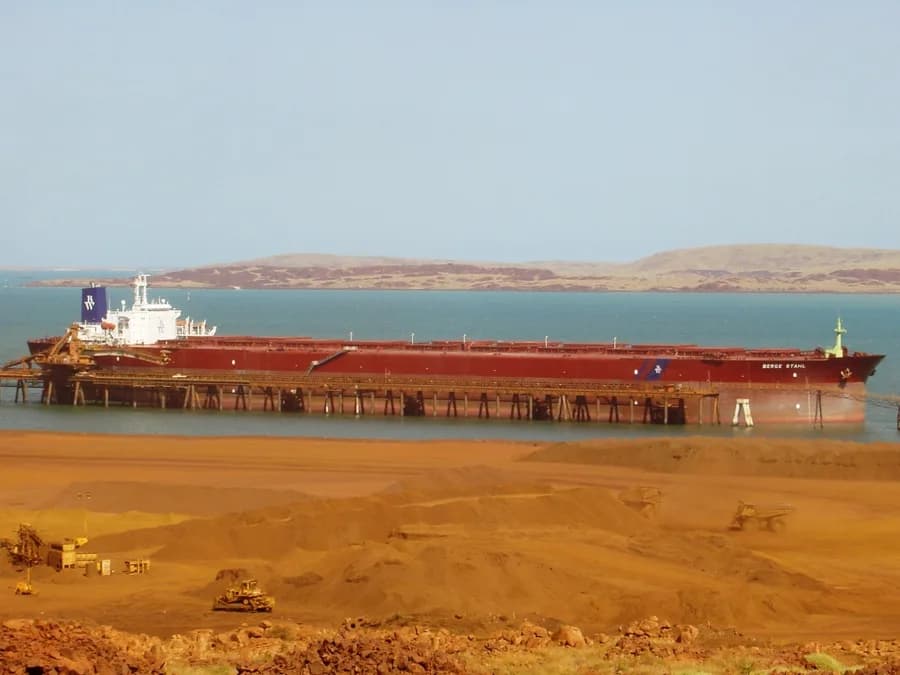
MS Berge Stahl was a bulk carrier. Until the delivery of MS Vale Brasil in 2011 she was the longest and largest iron ore carrier in the world. She was registered in Comoros. Before that, she was registered in Douglas, Isle of Man, Stavanger, Norway as well as in Monrovia, Liberia. An iron ore carrier, Berge Stahl had a capacity of 364,767 tonnes deadweight (DWT) . She was built in 1986 by Hyundai Heavy Industries. The vessel was 342.08 m (1,122 ft) long, had a beam, or width, of 63.5 m (208 ft), and a draft, or depth in the water, of 23 m (75 ft). Her MAN B&W 7L90MCE diesel engine drove a single 9 m (30 ft) propeller giving a top speed of 13.5 knots (25.0 km/h; 15.5 mph). Because of its massive size, Berge Stahl could originally only tie up, fully loaded, at two ports in the world, hauling ore from the Terminal Marítimo de Ponta da Madeira in Brazil to the Europoort near Rotterdam in the Netherlands. Even at these ports, passage must be timed to coincide with high tides to prevent the ship running aground. Berge Stahl made this trip about ten times each year, or a round-trip about every five weeks. The newly opened deep-water iron ore wharf at Caofeidian in China received the fully loaded Berge Stahl in October 2011, and several other Chinese ports have since opened to receive Vale's even larger Valemax ships. Berge Stahl can operate from other ports if not fully loaded.

GEOSTAHL

Visual Archive

Gallery

Explore More

Similar Vessels

Community

Vessel Comments