Technical Specifications
Overview
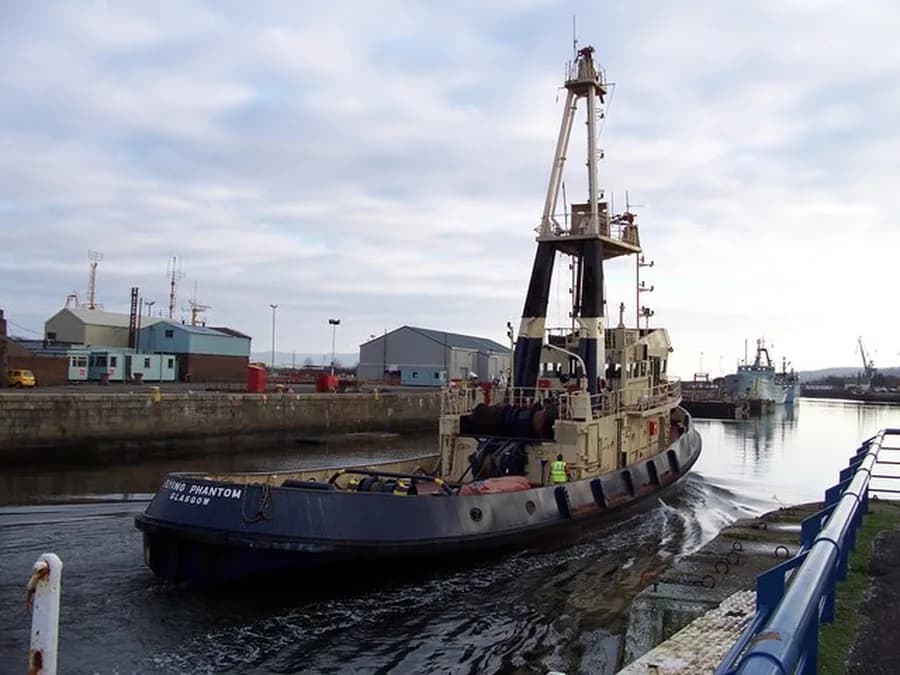
Flying Phantom was a tug built in 1981 for the Clyde Shipping Company and based in Greenock in Scotland. As a consequence of business takeovers and mergers, by 2001 she was owned by Svitzer Marine Ltd of Middlesbrough, though still based on the Clyde. She sank in the River Clyde at Clydebank on 19 December 2007, with the loss of Stephen Humphreys (captain), Robert Cameron (engineer) and Eric Blackley (deckhand) with only Brian Aitchison (mate) surviving. She was one of three tugs assisting the bulk carrier Red Jasmine. On the night of the accident, there was extremely poor visibility, due to heavy fog. Following the incident the Marine Accident Investigation Branch carried out a full investigation on the accident, and their report was published in September 2008. The MAIB concluded that failings in the safety regime of the harbour authority Clydeport, as well as operational shortcomings by the tug operator, and lack of an accepted international industry standard for tug tow line emergency release systems all contributed to the capsize of Flying Phantom and the loss of the three crew-members. The vessel was salvaged in January 2008, allowing evidence to be gathered for the MAIB report, and was subsequently scrapped. Earlier reports that criminal charges had been laid against Clydeport and Svitzer were confirmed on 22 April 2013.
Composite Risk
Multiple adverse factors, or a hard ship-specific signal, lift this hull above the fleet norm.
A coverage-weighted blend of the single component we could read for this hull; the weights renormalise over only the components present, so a thin read is never inflated and a hull is never credited a “safe 0” for a signal it has no row for. This headline is flagged low-confidence (a thin or structural-only read) and should not be treated as a verdict. Higher means riskier. Derived in-house from government-open port-State-control, flag, sanctions and our own vessel data; weight it by the coverage above.
Commercial
Price it in the Route Planner between any two commercial ports: ballast and laden legs, two fuels at live bunker prices, port and canal costs, the weather on the way, and the TCE set against the market.
Fleet Management

Visual Archive