Technical Specifications
Overview
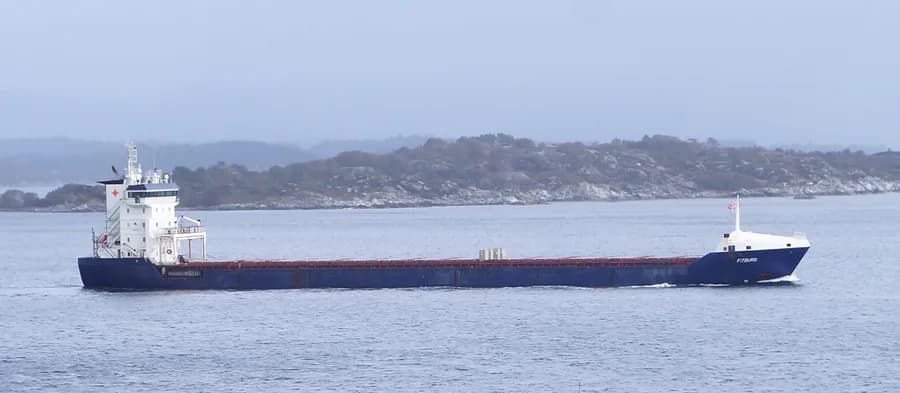
On 31 December 2025 at 4:53 EET, Finnish telecommuncation company Elisa noticed a disruption in a data cable connecting Finland and Estonia. Finnish police and coastguard approached the location in the Finnish exclusive economic zone and boarded the freighter Fitburg, which was found with its anchor lowered. The ship was traveling under the flag of Saint Vincent and the Grenadines and was, according to marine traffic website, en route from Saint Petersburg, Russia, to Haifa, Israel. The crew was detained and the ship was brought to the Finnish port of Kantvik, where it arrived at 17:00 EET. It was released on 12 January 2026. Four crewmembers had to stay in Finland while investigations continued.
Live Tracking
Intelligence
Verified reported figure. Band is peer-relative, not official IMO CII.
Compliance
Launching arrangements for rescue boats; Remote Means of control (opening,pumps,ventilation,etc.) Machinery spaces; Fire drills
Port-State-Control detentions.
Operational Status
Under way but in the slow band — effective capacity voluntarily withdrawn.
Read from the single most-recent AIS broadcast we hold for this hull — we keep no position history, so this is a point-in-time posture, not a dwell inference. Derived in-house from our own AIS feed; weight it by the broadcast age above.
Arrivals, time in port and the load/discharge inferred from the draught change — detected from AIS track history. An open call means the vessel is still in port (no departure observed yet).
Method: each call is a run of fixes inside a port’s geofence confirmed by a stop (or an AIS gap); load/discharge is the sign of the draught delta over the call. Indicative — arrivals before our AIS history began read from the first observation.
Time-in-port summed by port from the AIS-detected port-call history — the ports this vessel has spent the most time at, longest first.
Based on 1 completed call observed since — open calls (no departure yet) are excluded. The distribution sharpens as AIS history accrues.
Composite Risk
Multiple adverse factors, or a hard ship-specific signal, lift this hull above the fleet norm.
A coverage-weighted blend of the 3 components we could read for this hull — the weights renormalise over only the components present, so a thin read is never inflated and a hull is never credited a “safe 0” for a signal it has no row for. Higher means riskier. Derived in-house from government-open port-State-control, flag, sanctions and our own vessel data; weight it by the coverage above.
Estimated
Other · summer draught 5.2 m · 22.1 t per cm immersion
Estimate only — modelled from deadweight (deadweight regression) using a first-principles hydrostatic model, not measured hydrostatic tables. The design draught it is anchored to is unreliable across the fleet.
Commercial
Fleet Management

Visual Archive
Explore More