Technical Specifications
Overview
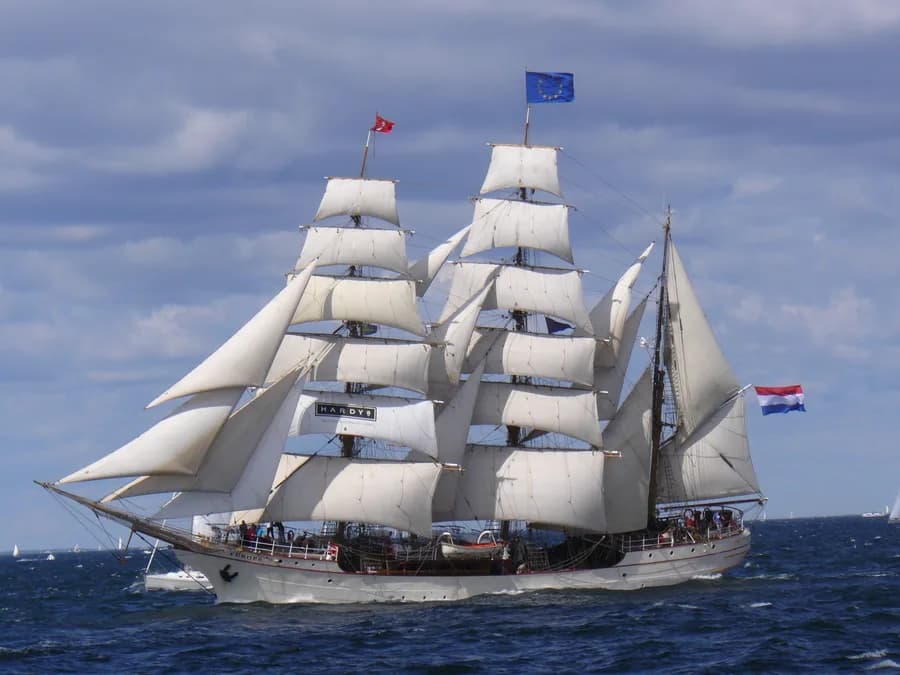
Europa is a steel-hulled barque registered in the Netherlands. Originally she was a German lightship, named Senator Brockes and built in 1911 at the H.C. Stülcken & Sohn shipyard in Hamburg, Germany. Until 1977, she was in use by the German Federal Coast Guard as a lightship on the river Elbe. A Dutchman bought the vessel (or what was left of her) in 1985 and in 1994 she was fully restored as a barque, a three-mast rigged vessel, and retrofitted for special-purpose sail-training. Europa cruises worldwide and accepts paying voyage crew (trainees) for short or long trip segments, including ocean crossings, Sail Training Association races, and annual voyages to Antarctica, and between South Georgia, Tristan da Cunha, and Cape Town. In 2002 and 2013 she rounded Cape Horn. In 2010 she participated in Velas Sudamerica 2010, an historical Latin American tour by eleven tall ships to celebrate the bicentennial of the first national governments of Argentina and Chile. In 2013-2014 Europa circumnavigated the world together with two other Dutch tall ships, Tecla and Oosterschelde. They sailed from South Africa to Mauritius, Australia and New Zealand. In October 2013 Europa participated in the International Fleet Review 2013 in Sydney. From New Zealand, the ship sailed an official Cape Horn rounding (October - December 2013).
Composite Risk
Multiple adverse factors, or a hard ship-specific signal, lift this hull above the fleet norm.
A coverage-weighted blend of the single component we could read for this hull; the weights renormalise over only the components present, so a thin read is never inflated and a hull is never credited a “safe 0” for a signal it has no row for. This headline is flagged low-confidence (a thin or structural-only read) and should not be treated as a verdict. Higher means riskier. Derived in-house from government-open port-State-control, flag, sanctions and our own vessel data; weight it by the coverage above.
Commercial
Price it in the Route Planner between any two commercial ports: ballast and laden legs, two fuels at live bunker prices, port and canal costs, the weather on the way, and the TCE set against the market.

Visual Archive