Technical Specifications
Overview
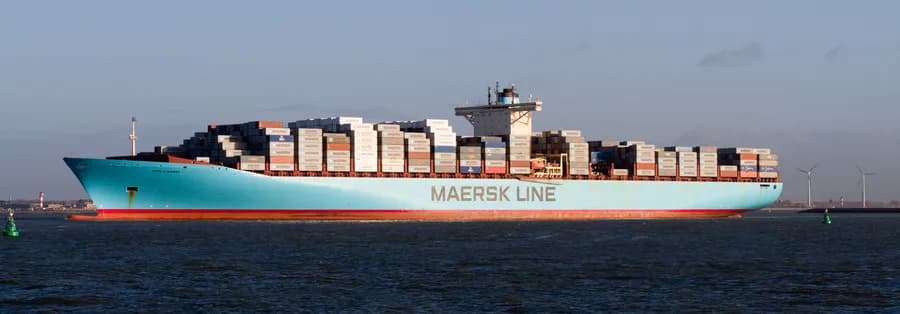
Estelle Mærsk is a container ship owned and run by the Maersk Line. She was, in 2009, the largest ever built by terms of gross tonnage. Estelle Mærsk has a capacity of 11,000 twenty-foot equivalent units (TEU), including around 1,000 40-foot (12 m) reefer containers, though a maximum capacity of 13,500 TEU is claimed. She is identical to the seven other ships in the E class, the first built of which was Emma Maersk. The Estelle Mærsk is 1,302.5 feet (397.0 m) long and has a gross tonnage of 151,687. Her beam (width) is 183.7 feet (56.0 m). She is powered by a Wärtsilä diesel engine, assisted by a waste heat recovery system, that can produce between 80,000 and 90,000 kilowatts (110,000 and 120,000 hp) of power. A coat of environmentally safe silicone paint is used on the hull below the waterline, reducing drag and thus increasing speed and saving up to 1,200 tons of fuel per year. Estelle Mærsk was built by Odense Steel Shipyard of Denmark in 2006. Mærsk claim that these technologies, and staying below 10 knots (19 km/h; 12 mph) whenever possible, reduce emissions by around 25% compared to other ships. An older ship of the same name was attacked with rocket propelled grenades by Iranians near Dubai in 1987, many years before the current Estelle was built.
Intelligence
Verified reported figure. Band is peer-relative, not official IMO CII.
Composite Risk
Multiple adverse factors, or a hard ship-specific signal, lift this hull above the fleet norm.
A coverage-weighted blend of the single component we could read for this hull; the weights renormalise over only the components present, so a thin read is never inflated and a hull is never credited a “safe 0” for a signal it has no row for. This headline is flagged low-confidence (a thin or structural-only read) and should not be treated as a verdict. Higher means riskier. Derived in-house from government-open port-State-control, flag, sanctions and our own vessel data; weight it by the coverage above.
Commercial
Price it in the Route Planner between any two commercial ports: ballast and laden legs, two fuels at live bunker prices, port and canal costs, the weather on the way, and the TCE set against the market.
Fleet Management

Visual Archive