Technical Specifications
Overview
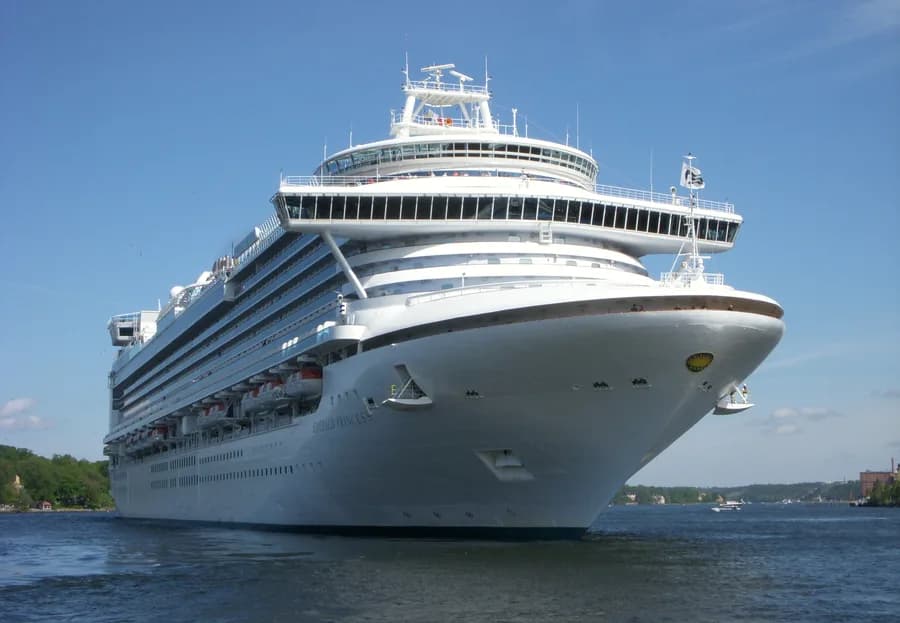
Emerald Princess is a Crown-class cruise ship for Princess Cruises that entered service in April 2007. Her sister ships include Ruby Princess and Crown Princess. Emerald Princess launched from the Italian shipyard of Fincantieri Monfalcone on 1 June 2006. She was then handed over to Princess Cruises on 24 March 2007. Emerald Princess was christened on 13 May 2007, in Greece.
Live Tracking
Most time stopped at Port of Vancouver — 3 d across 7 stays.
Derived from the AIS track — runs of near-zero speed (anchored, moored or drifting) snapped to the nearest port. Builds up as we observe the vessel.
Resolved from the live AIS destination. Distance is the real sea route (around land and through canals). The computed ETA is steaming time at the vessel’s passage speed, and does not include any wait for a berth. A destination is the crew’s stated intent, not a confirmed fixture.
Intelligence
Verified reported figure. Band is peer-relative, not official IMO CII.
AIS-derived from our live feed.
Compliance
On 13 September 2024, the bulk carrier "ALGOMA INTEGRITY" reported having experienced a close quarters situation with passenger tenders of the "EMERALD PRINCESS" in Halifax Harbour, NS.
On 14 April 2019, the passenger vessel "EMERALD PRINCESS", under the conduct of a pilot, reported a fire in its dry store area due to an electrical problem, in Esquimalt Harbour, BC. The crew members extinguished the fire immediately. No injuries or pollution were reported.
Recorded marine occurrences naming this vessel.
Operational Status
Making way at sea speed on its latest broadcast.
Read from the single most-recent AIS broadcast we hold for this hull — we keep no position history, so this is a point-in-time posture, not a dwell inference. Derived in-house from our own AIS feed; weight it by the broadcast age above.
Arrivals, time in port and the load/discharge inferred from the draught change — detected from AIS track history. An open call means the vessel is still in port (no departure observed yet).
Method: each call is a run of fixes inside a port’s geofence confirmed by a stop (or an AIS gap); load/discharge is the sign of the draught delta over the call. Indicative — arrivals before our AIS history began read from the first observation.
Time-in-port summed by port from the AIS-detected port-call history — the ports this vessel has spent the most time at, longest first.
Based on 11 completed calls observed since — open calls (no departure yet) are excluded. The distribution sharpens as AIS history accrues.
Composite Risk
Multiple adverse factors, or a hard ship-specific signal, lift this hull above the fleet norm.
A coverage-weighted blend of the single component we could read for this hull — the weights renormalise over only the components present, so a thin read is never inflated and a hull is never credited a “safe 0” for a signal it has no row for. This headline is flagged low-confidence (a thin or structural-only read) and should not be treated as a verdict. Higher means riskier. Derived in-house from government-open port-State-control, flag, sanctions and our own vessel data; weight it by the coverage above.
Fleet Management

Visual Archive
Explore More