Technical Specifications
Overview
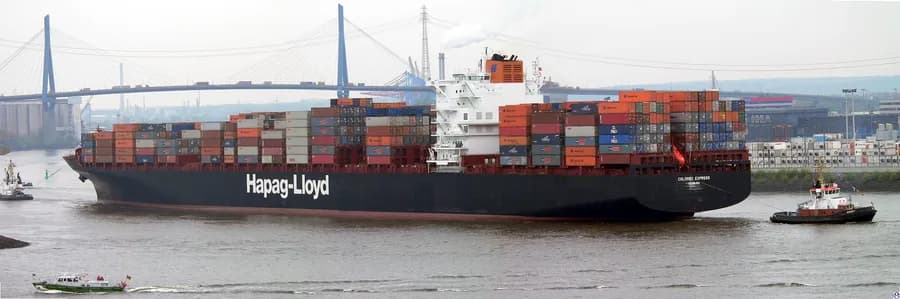
Colombo Express is a container ship. When launched in 2005, she was claimed by her owner to be the world's largest container ship, a title she held until Emma Mærsk was launched in 2006. Colombo Express holds 8,749 twenty-foot equivalent units (TEU), 730 refrigerated (reefer) TEUs, is 335 metres (1,099 ft) long, and has a beam, or width, of 43 metres (140 ft). She is owned by the German shipping company Hapag-Lloyd, and operated by its Hapag-Lloyd Container Line division. She is named for Colombo, the largest city in Sri Lanka, which the predecessor company, North American Lloyd, first called on in 1886. She is the first of eight proposed Colombo Express class vessels, and is only slightly larger (approximately 4%) than her Savannah Express class cousins, the 8400 TEU (700 reefer) ships Savannah Express and Houston Express. Colombo Express has a gross tonnage of 93,750 and had a deadweight capacity of 104,400 tonnes. Her rated speed is 25.0 knots (46.3 km/h). Built in South Korea by Hyundai Heavy Industries in 2004–2005, she was christened on 11 April 2005, and her diesel engine generates 69,700 kilowatts (93,500 hp) of power. Colombo Express operates out of the home port of Hamburg, and will mainly travel from Europe to Southeast Asia and back in 56-day round-trips.
Intelligence
Verified reported figure. Band is peer-relative, not official IMO CII.
Composite Risk
Multiple adverse factors, or a hard ship-specific signal, lift this hull above the fleet norm.
A coverage-weighted blend of the single component we could read for this hull; the weights renormalise over only the components present, so a thin read is never inflated and a hull is never credited a “safe 0” for a signal it has no row for. This headline is flagged low-confidence (a thin or structural-only read) and should not be treated as a verdict. Higher means riskier. Derived in-house from government-open port-State-control, flag, sanctions and our own vessel data; weight it by the coverage above.
Commercial
Price it in the Route Planner between any two commercial ports: ballast and laden legs, two fuels at live bunker prices, port and canal costs, the weather on the way, and the TCE set against the market.
Fleet Management

Visual Archive