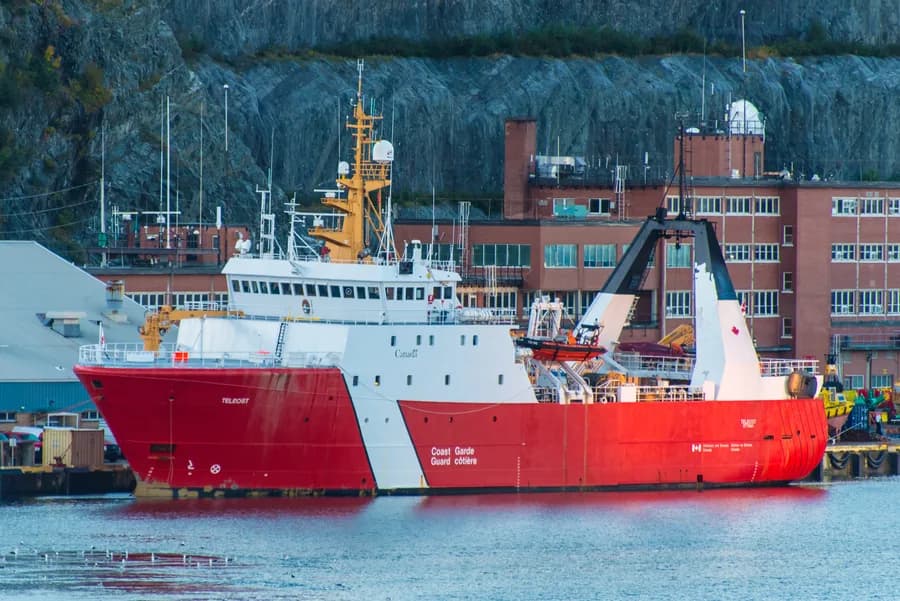
Technical Specifications
Compliance
On 03 June 2026, the Canadian Coast Guard Ship "TELEOST", with 24 people on board, reported having fouled a subsea utility cable while heaving up its anchor in Great Triton Harbour, NL. The crew freed the anchor and reported minor damage to the cable outer sheath.
On 09 January 2024, the Canadian Coast Guard Ship "TELEOST" reported having sustained a total loss of electrical power and propulsion off Black Tickle, NL. The crew effected repairs and the vessel proceeded to a nearby anchorage for further assessment.
On 12 May 2022, the tugs "CRT EXPRESS" and the "DALTON DEFENDER", while berthing the barge "CRT 002" at Pier 8, reported the barge colliding with the Canadian Coast Guard Ship "TELEOST", which was located at Pier 9, in St. John's Harbour, NL. There were no injuries to personnel and minor damage to the "TELEOST".
On 07 March 2021, the Canadian Coast Guard research vessel "TELEOST" reported sustaining an engine control failure while approaching the dock at the Bedford Institute of Oceanography. The vessel anchored and its crew troubleshot the engine to perform repairs.
On 01 October 2020, the Canadian Coast Guard research vessel "TELEOST" reported that a crew member had sustained an injury on the trawl deck while the vessel was 10 nautical miles west of Cape Gage, PE.
On 26 February 2020, the Canadian Coast Guard Ship "TELEOST" sustained a small fire on the main engine exhaust pipe. The crew extinguished the fire using a nearby fire extinguisher.
On 18 August 2017, the Canadian Coast Guard survey/research vessel "TELEOST" reported a main engine cooling system failure near Anticosti Island, QC. The vessel's crew carried out repairs.
On 19 May 2017, the Canadian Coast Guard research vessel "TELEOST" reported a crew member had sustained serious burns from scalding 135 nautical miles NE of St. John's, NL. The vessel subsequently steamed to port where the crew member was hospitalized.
Recorded marine occurrences naming this vessel.
Composite Risk
Multiple adverse factors, or a hard ship-specific signal, lift this hull above the fleet norm.
A coverage-weighted blend of the single component we could read for this hull; the weights renormalise over only the components present, so a thin read is never inflated and a hull is never credited a “safe 0” for a signal it has no row for. This headline is flagged low-confidence (a thin or structural-only read) and should not be treated as a verdict. Higher means riskier. Derived in-house from government-open port-State-control, flag, sanctions and our own vessel data; weight it by the coverage above.
Commercial
Price it in the Route Planner between any two commercial ports: ballast and laden legs, two fuels at live bunker prices, port and canal costs, the weather on the way, and the TCE set against the market.

Visual Archive