Technical Specifications
Compliance
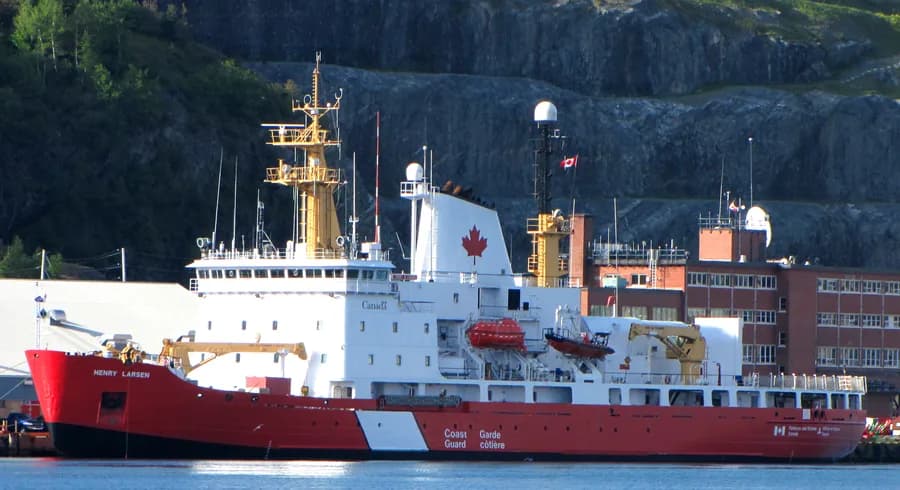
On 02 October 2025, the Canadian Coast Guard Ship "HENRY LARSEN" reported a fire caused by welding sparks while in refit alongside in St. John's, NL. The fire was controlled with an extinguisher, leaving no apparent damage.
On 15 February 2025, the Canadian Coast Guard Ship "HENRY LARSEN" reported experiencing severe weather and heavy rolling that caused machinery issues and minor damage to the vessel off Wild Cove, NL. Seven crew members sustained minor injuries.
On 14 June 2024, the Canadian Coast Guard Ship "HENRY LARSEN", with 37 people on board, reported having sustained a fire on deck during hot work while alongside in St. John's, NL. The fire was extinguished and the crew resumed its refit operations.
On 13 March 2024, the Canadian Coast Guard Ship "HENRY LARSEN" reported having made bottom contact during an icebreaking operation in St. Barbe Harbour, NL. The vessel proceeded to Corner Brook, NL to conduct a complete damage assessment.
On 30 May 2022, the Canadian Coast Guard Ship "HENRY LARSEN", with 40 people on board, reported having sustained a fire while conducting welding operations in the harbour of St. John's, NL. The fire was extinguished by the crew.
On 09 November 2020, the Canadian Coast Guard ship "HENRY LARSEN" reported that a propane torch had ignited while crew were performing hot work in the engine room. No damage was reported.
On 03 July 2020, the Canadian Coast Guard ship "HENRY LARSEN", with 44 people on board, reported a fire in the laundry room 4.9 nautical miles north-northeast of Cape St. John, NL. The fire was extinguished and no injuries or pollution were reported.
On 24 March 2017, the passenger ferry "APOLLO" collided with the helicopter hangar sanctions on the "C.C.G.S. HENRY LARSON" during an ice escort. There were minor damages to both vessels. The escort continued until the vessels reached port. There were no injuries or pollution reported.
Recorded marine occurrences naming this vessel.
Composite Risk
Multiple adverse factors, or a hard ship-specific signal, lift this hull above the fleet norm.
A coverage-weighted blend of the single component we could read for this hull; the weights renormalise over only the components present, so a thin read is never inflated and a hull is never credited a “safe 0” for a signal it has no row for. This headline is flagged low-confidence (a thin or structural-only read) and should not be treated as a verdict. Higher means riskier. Derived in-house from government-open port-State-control, flag, sanctions and our own vessel data; weight it by the coverage above.
Commercial
Price it in the Route Planner between any two commercial ports: ballast and laden legs, two fuels at live bunker prices, port and canal costs, the weather on the way, and the TCE set against the market.

Visual Archive