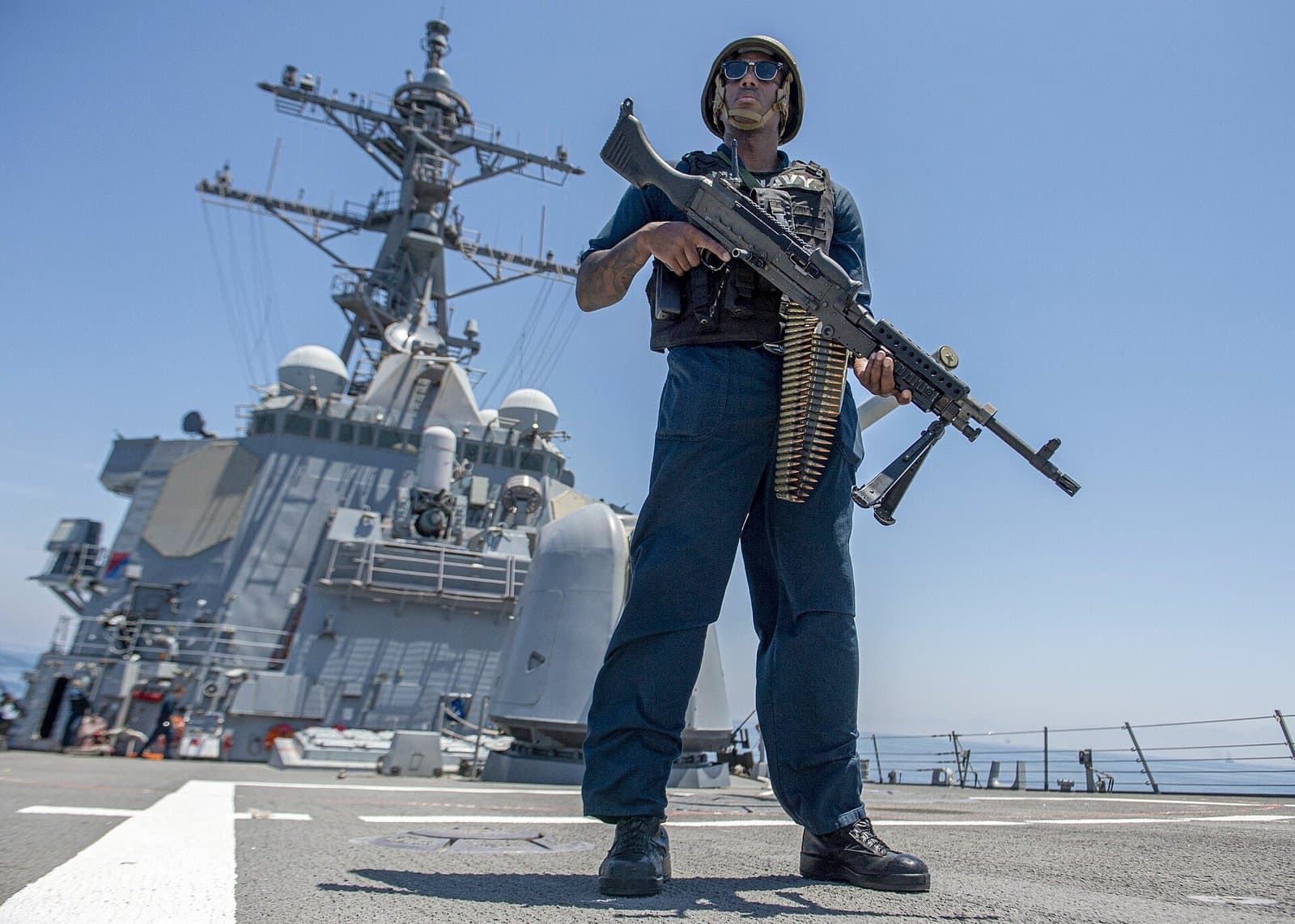
The first escorted transits of Project Freedom ran into combat within hours of starting. On May 4, Iranian forces launched cruise missiles, drones and small boats against commercial vessels and US Navy warships in the Strait of Hormuz; US Army Apache and Navy Seahawk helicopters sank six of the attacking boats that morning, seven by some accounts, and shipboard defenses brought down the incoming missiles, according to Stars and Stripes. No US vessels were damaged.
Two US-flagged merchant ships completed the passage safely hours later, the first commercial transits under military escort since the strait effectively closed. But the week cut both ways. On May 5 a land-attack cruise missile struck the containership CMA CGM San Antonio, injuring eight crew members, and Tehran answered the convoys by standing up a body that claims the right to license every transit of the strait.
The first convoy battle
President Trump announced Project Freedom on May 3, with CENTCOM committing destroyers, more than 100 aircraft, unmanned platforms and some 15,000 personnel to the reopening effort. The May 4 engagement was the first direct naval combat of that effort. "U.S. forces are helping the international community in restoring the flow of global commerce," CENTCOM commander Admiral Brad Cooper said in remarks carried by Stars and Stripes. The stakes are measured in the backlog: ships from 87 nations were waiting to move through the strait as the first convoys formed. The case for escorts had been hardened in late April, when Iranian forces fired on two MSC containerships at the strait's mouth.
San Antonio struck, eight crew hurt
The escort umbrella does not yet cover everyone. On May 5 the CMA CGM San Antonio (IMO 9294173) was hit by a land-attack cruise missile inside the strait. Eight Filipino crew members were injured and evacuated. A day earlier, the South Korean containership HMM Namu suffered an explosion and fire while at anchor off the UAE.
The scale of the exposed population is stark. Joint Chiefs of Staff Chairman Caine said on May 5 that 22,500 mariners aboard more than 1,550 commercial vessels remained trapped inside the Gulf. Set against that number, two escorted transits are a proof of concept, not a solution; at any plausible convoy tempo, clearing the backlog would take months, and every ship still at anchor remains within reach of shore-based missiles.
A rival authority for the strait
Also on May 5, Iran founded the Persian Gulf Strait Authority, a body established to license and regulate all transits of Hormuz. Industry reports describe permit requests handled by email, fees running as high as $2 million payable in Bitcoin or yuan, and an outright ban on Israeli-linked ships.
Washington had pre-positioned its answer. A May 1 advisory from the US Treasury's Office of Foreign Assets Control warned that payments to Iran for passage create sanctions exposure regardless of the payment method. The result, within 48 hours, is a strait with two competing authorities: a CENTCOM-protected corridor on one side and a pay-to-pass regime on the other, both layered over the US naval blockade in force since April 13.
The tests ahead
The immediate question is cadence: how many escorted transits CENTCOM can run each week, and whether May 4's clean intercept record survives repetition against missiles, drones and swarming boats. The second is commercial behavior. An owner with a ship trapped inside the Gulf must now choose between waiting for a convoy slot, paying a toll that OFAC says may itself trigger sanctions, or staying at anchor in a war zone; each option opens a different conversation with insurers, charterers and flag states. For the San Antonio, the questions are nearer term, starting with the extent of the damage and how she can be brought out of a strait that remains under fire. The two-authority structure itself looks unstable. Every escorted transit that ignores the PGSA undermines its claim to control, and every fee paid undermines the convoys; the coming weeks of transits, not statements, will decide which model sets the strait's rules.

As Editor in Chief of The Maritime, I lead content development, interviews, and digital storytelling across our multimedia maritime platform. With over 10 years of experience in the maritime industry, I create and publish in-depth stories and video features that highlight key players, emerging trends, and operational realities across global shipping. Before launching The Maritime, I worked as a Vessel Operator at Imza Marine A.S., gaining hands-on commercial shipping and voyage operations experience. I also served as Marketing Communications Specialist at Gimas Ship Supply & Services, where I managed corporate communication, digital strategy, and industry outreach for shipowners and maritime clients. I hold a Master’s degree in Maritime Transportation Management from Istanbul Technical University and a Master’s degree in Publishing from Marmara University. My work is driven by the belief that the maritime world deserves strong, informed, and accessible media representation. I am committed to sharing the stories of maritime professionals and contributing to the sector’s visibility, knowledge exchange, and future development.