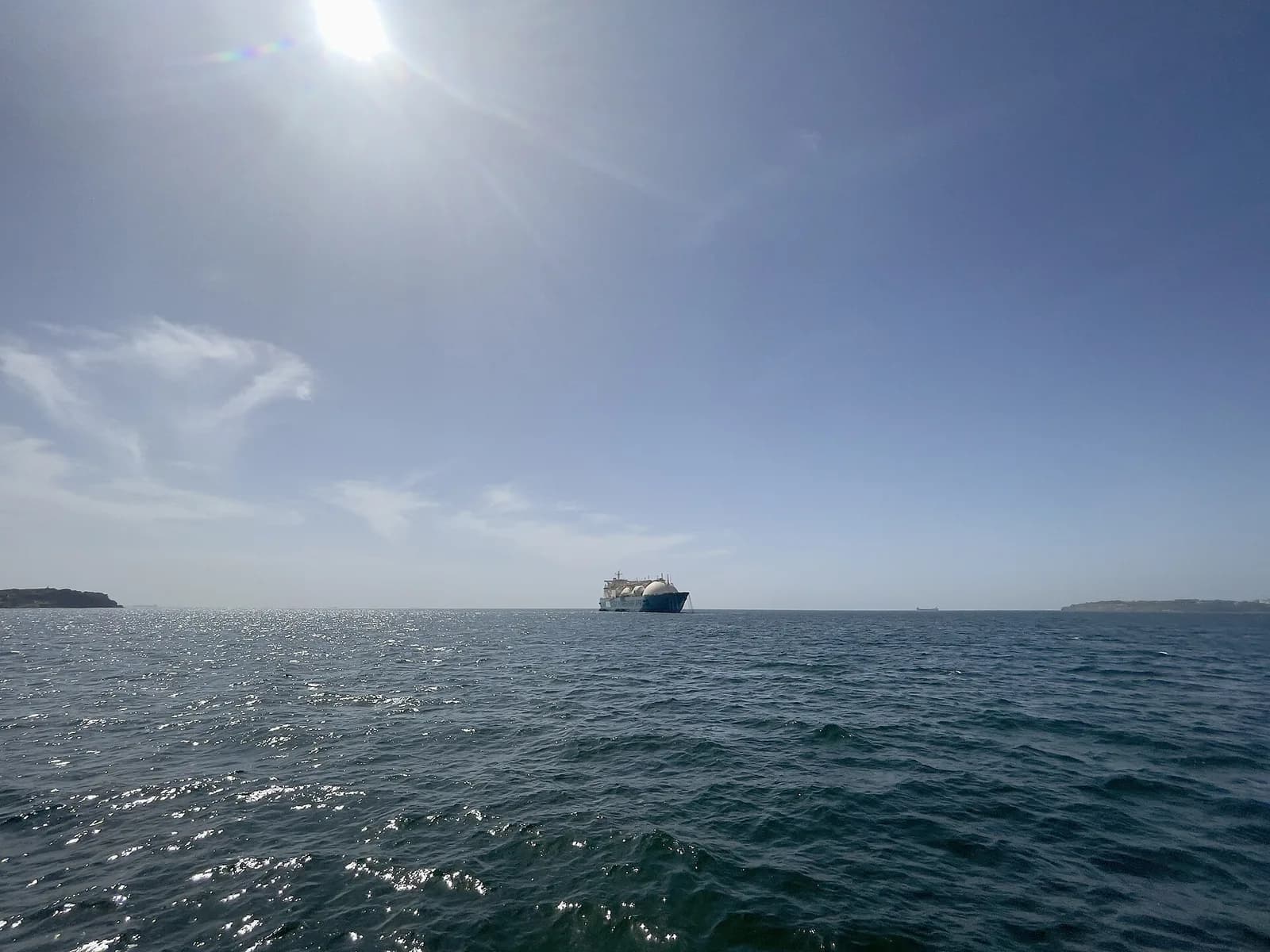
The Qatari-flagged Q-Flex LNG carrier Al Rekayyat was struck by a projectile on her port side at the engine room at 2119 UTC on July 6, while southbound about 8 nautical miles east of Limah, Oman, according to UKMTO Warning 080-26. The strike started an engine-room fire aboard the fully laden vessel. All crew were evacuated safely and there were no injuries, operator Nakilat confirmed in a statement carried by The Peninsula on July 8.
The attack is a first: no Qatari LNG ship had been hit since the war began at the end of February 2026. It came on what Bloomberg described as the biggest day of attacks near Hormuz since the interim peace deal, and it reached into the fleet of the one Gulf state mediating between Washington and Tehran.
Distress, fire and a night of attacks
The ship's master reported by radio: "Status: engine room fire and full of smoke. Unable to assess further damage." The same night, a Saudi supertanker believed to be Bahri's Wedyan was hit, and industry reports named the Liberia-flagged ADNOC LPG tanker Al Maryah among the vessels affected. Security consultancy EOS Risk assessed the weapon as a drone or missile. A US official said initial indications pointed to Iran, and Axios reported that the IRGC fired at least two missiles. Iran made no formal claim, though state television implied IRGC involvement on the grounds that the ship's route had not been authorized by Tehran. Qatar condemned Iran over the strike, The National reported.
A laden LNG casualty is a different problem
Fire aboard a loaded LNG carrier poses a risk that crude and product tankers do not: a breached cargo tank would change the scale of the casualty entirely, and responders treated the Al Rekayyat as at risk of explosion in the first hours. By July 8 the vessel lay stationary near the entrance to the strait, close to the Omani coast, with a tug and a service ship alongside, the fire being extinguished and the LNG tanks intact, as she awaited salvage. For underwriters the event is structural rather than incidental. War-risk pricing for LNG transits through Hormuz had leaned on the assumption that gas carriers sat outside the target set; the Al Rekayyat is the data point that removes it, and cover for laden LNG voyages in these waters will now be priced against a demonstrated loss scenario rather than a theoretical one.
Pressure aimed at the mediator
Qatar is not a bystander in this conflict; it is the mediator in the US-Iran talks. That makes the choice of target read less like an error and more like a message directed at the negotiation itself. Doha's decision to condemn Iran publicly, a step a neutral broker does not take lightly, measures how seriously the strike landed. The attack is also the first flagrant test of whether the memorandum of understanding on strait transits can survive contact with events, and the answer so far is not reassuring.
What comes next
Whatever signal the strike was meant to send, it was not a closing note. At 2224 UTC on July 13, UKMTO issued Warning 085-26 after another tanker was struck about 13 nautical miles east of Limah, almost the same stretch of water where the Al Rekayyat was hit a week earlier.
UKMTO WARNING 085-26 - ATTACK
@UK_MTO July 13, 2026
Three things bear watching from here: the salvage of the Al Rekayyat and whether her cargo is transferred without further incident; the speed and scale of war-risk repricing for LNG voyages through Hormuz; and whether attacks on the mediator's own fleet push Doha to rethink its shipping posture or its role at the table. A second strike in the same waters within a week answers the de-escalation question for now.
Cover image: cowbridgeguide.co.uk, CC BY 3.0, via Wikimedia Commons.
Cover image: Fawaz.tairou, CC BY-SA 4.0, via Wikimedia Commons.

As Editor in Chief of The Maritime, I lead content development, interviews, and digital storytelling across our multimedia maritime platform. With over 10 years of experience in the maritime industry, I create and publish in-depth stories and video features that highlight key players, emerging trends, and operational realities across global shipping. Before launching The Maritime, I worked as a Vessel Operator at Imza Marine A.S., gaining hands-on commercial shipping and voyage operations experience. I also served as Marketing Communications Specialist at Gimas Ship Supply & Services, where I managed corporate communication, digital strategy, and industry outreach for shipowners and maritime clients. I hold a Master’s degree in Maritime Transportation Management from Istanbul Technical University and a Master’s degree in Publishing from Marmara University. My work is driven by the belief that the maritime world deserves strong, informed, and accessible media representation. I am committed to sharing the stories of maritime professionals and contributing to the sector’s visibility, knowledge exchange, and future development.