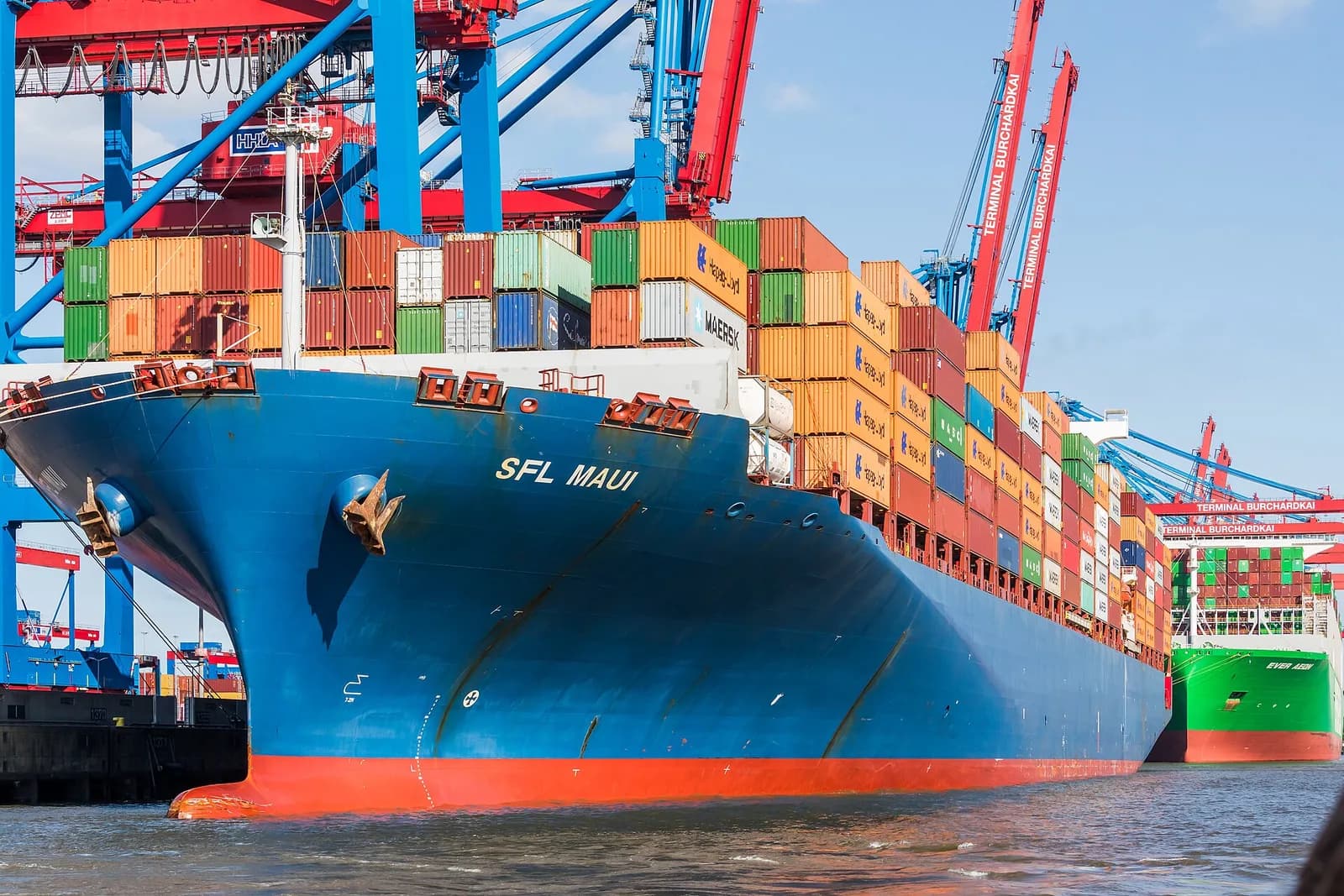
ABS has granted approval in principle to a conceptual 15,000 TEU containership powered by molten salt reactors, a design developed by the Korea Atomic Energy Research Institute, the Korea Research Institute of Ships and Ocean Engineering and Samsung Heavy Industries, The Korea Times reported on July 16. The Neopanamax-sized vessel would run two small modular reactors at a design speed of 25 knots, with no fuel tanks and no funnel.
The approval matters less for this single ship than for the pattern it completes. It is the latest in a cluster of nuclear design approvals from major classification societies in mid-2026: ABS approved a nuclear cargo vessel concept from MIT, HD KSOE and Capital Maritime on June 5, and Lloyd's Register has approved a molten salt reactor car carrier concept. Class societies are no longer stamping one-off curiosities; they are building a systematic capability to review nuclear designs.
Inside the design
The reactors are based on KAERI's marine molten salt technology, known as MARINA, while KRISO and Samsung Heavy handled the hull design, reactor placement and power control systems. The two units share electrical load with built-in redundancy and route surplus output into onboard energy storage. Both sit at the center of the hull, the position best protected from wave impact and collision, with shielding placed around the accommodation block. The arrangement reads as an attempt to answer the objections a class surveyor would raise first, rather than a rendering built for a press release.
Molten salt chemistry carries the concept's central safety argument. If the reaction fails, the liquid fuel hardens and encases its radioactive material, a passive behavior that does not depend on operator action or external power. The design also strips away two defining features of a conventional boxship: there are no bunker tanks to fill and no funnel to vent.
A pattern, not a one-off
The project runs under South Korea's K-Moonshot program at the Advanced Reactor Research Institute, whose director, Cho Jin-young, called the approval "an important milestone," as. Samsung Heavy has been iterating on the technology for some time; it took an approval in principle for a 100-MWth molten salt reactor LNG carrier at Gastech in September 2025. Taken together with the June approvals, the file of reviewed nuclear concepts now spans cargo ships, car carriers, gas carriers and container tonnage, a breadth catalogued by World Nuclear News. Each review forces a society to codify how it will assess shielding, containment and crew protection at sea, and that accumulated method is what turns the next application from a research exercise into a process.
The economics of 25 knots
Most zero-carbon propulsion candidates ask an owner to accept cost and complexity for the same commercial service. This concept inverts the pitch. A 25-knot design speed sits far above the pace the deep-sea container trades settled into as fuel costs and carbon rules pushed the fleet to slow down, and a ship that never diverts for bunkers keeps that speed across an entire rotation. The commercial case is therefore not only about zero emissions; it is about schedule reliability, port coverage and cargo that pays for transit time. If the sums work, nuclear power would compete on service quality rather than on compliance alone.
The road ahead
An approval in principle validates a concept against class requirements; it is not an order, and no shipowner has committed to build the vessel. The developers' stated next steps are reactor-ship interface engineering, safety verification and demonstration work. The harder questions sit beyond class and yard entirely: which port states would admit a reactor-powered merchant ship, and under what IMO framework it would trade, gaps mapped in a July 7 analysis by K&L Gates. Every approval in principle granted this year defers those questions to a later stage. The measure of progress from here is not the next concept approval but the first regulator, port and flag state prepared to answer them.
Cover image: kees torn, CC BY-SA 2.0, via Wikimedia Commons.
Cover image: Gordon Leggett, CC BY 4.0, via Wikimedia Commons.

As Editor in Chief of The Maritime, I lead content development, interviews, and digital storytelling across our multimedia maritime platform. With over 10 years of experience in the maritime industry, I create and publish in-depth stories and video features that highlight key players, emerging trends, and operational realities across global shipping. Before launching The Maritime, I worked as a Vessel Operator at Imza Marine A.S., gaining hands-on commercial shipping and voyage operations experience. I also served as Marketing Communications Specialist at Gimas Ship Supply & Services, where I managed corporate communication, digital strategy, and industry outreach for shipowners and maritime clients. I hold a Master’s degree in Maritime Transportation Management from Istanbul Technical University and a Master’s degree in Publishing from Marmara University. My work is driven by the belief that the maritime world deserves strong, informed, and accessible media representation. I am committed to sharing the stories of maritime professionals and contributing to the sector’s visibility, knowledge exchange, and future development.