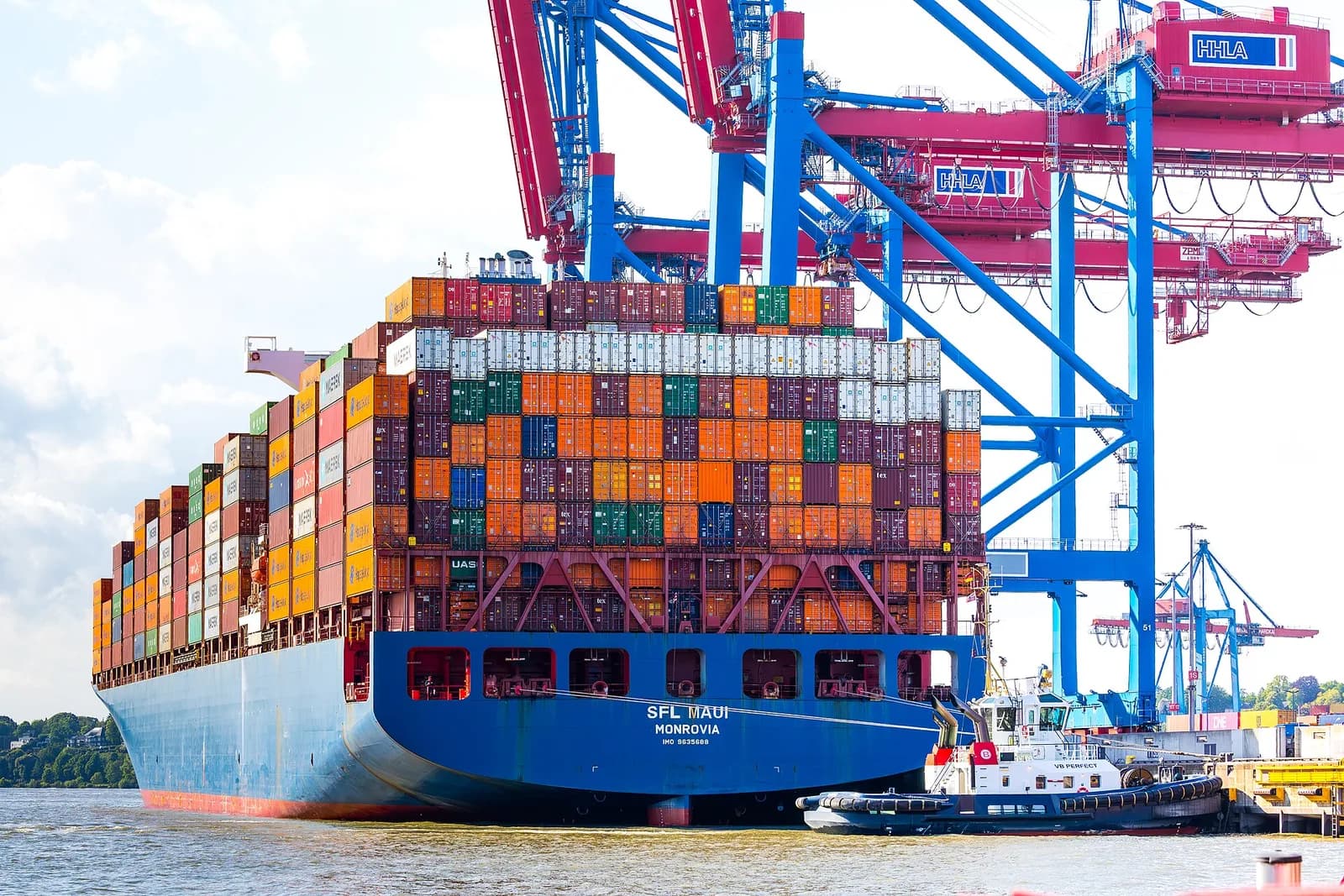
Transpacific container rates have roughly doubled since May. Freightos put its FBX Asia to US West Coast assessment at $7,500 per FEU on July 14, up 13 percent in a week, with the East Coast lane above $9,000 after a 6 percent gain, according to its July 14 market update. Both lanes have added about $4,000 per FEU since May, when West Coast spot rates sat near $3,200.
The rally is the product of two shocks landing in the same quarter: a demand shock from tariff-deadline front-loading and a supply shock from the Strait of Hormuz and spreading port congestion. It is also, as of mid-July, showing its first crack. Drewry's World Container Index fell 2 percent on July 16, its first decline after ten consecutive weekly gains.
How the rally built
The surge began with the June 1 general rate increases and peak season surcharges. Freightos recorded the FBX01 West Coast lane jumping 51 percent week on week to $4,800 per FEU, with FBX03 to the East Coast rising 25 percent to $6,300. Behind the GRIs sat a calendar of deadlines: the expiry of the Section 122 global duty around July 24, a date Drewry has flagged, a USTR Section 301 hearing on July 7, and the EU's removal of its de minimis exemption on July 1. With the May US-China tariff truce opening a 90-day window, a quarter's worth of volume was compressed into May and June bookings.
By July 1, Freightos assessed the West Coast at $6,200, up 120 percent since mid-May, and the East Coast at $8,000, roughly $1,000 above its 2025 summer peak, while Asia to Mediterranean rates ran $3,000 above their 2025 highs. Linerlytica reported that the mid-June increases held, called the run the strongest rate climb since the original Red Sea diversions began, and noted carriers preparing July GRIs of as much as $5,000 per FEU. The National Retail Federation expects July US imports to reach 2.47 million TEU, a record.
#Freightos Weekly Update: #Ocean #rates steady as shippers brace for July hikes
@container_news July 2026
Hormuz does the supply side
The supply half of the squeeze runs through the Gulf. After the June US-Iran memorandum of understanding broke down, Iran declared the strait off limits to vessels that do not obtain Iranian permission. Freightos tracked crude prices up 10 percent and bunker fuel up around 5 percent on the escalation in its July 14 update. More than 50 container ships remain stranded inside the Gulf, and only nine had departed after the deal, six of them Iranian, according to Linerlytica's week 25 report. Every hull trapped at anchor, and every ship queuing off a congested port elsewhere, subtracts effective capacity from a market already paying peak-season prices.
The first crack
Drewry's World Container Index composite reached $4,639 per 40ft container on July 9, its tenth straight weekly gain and its highest reading since September 2024. On July 16 it slipped 2 percent to $4,547, with Shanghai to Los Angeles down 3 percent at $6,272 and Shanghai to New York flat at $7,879. Drewry observed that the "strong upwards momentum seen during the peak season is beginning to subside." The WCI and Freightos' FBX are separate assessments built on different methodologies, and their absolute levels are not comparable, but the direction of the turn is the signal.
The failure of fresh increases points the same way. CMA CGM's July 15 FAK rates of $7,000 per 40ft box from Asia to North Europe and $7,900 to $8,500 to the Mediterranean failed to hold, and transpacific GRIs of $2,000 to $3,000 attempted the same day landed on softening spot markets. Carriers are already reaching for the other lever: three transpacific and four Asia-Europe blank sailings were announced in the week of July 9, with nine transpacific blanks scheduled for the week after.
The cliff after July 24
The front-loading that built the rally has an expiry date printed on it. The National Retail Federation sees August imports falling 10 percent month on month from July's record, and once the July 24 tariff window closes there is no obvious demand engine behind it. Freightos noted carriers still pursuing mid-July increases of up to $1,000 per FEU in the week of July 14, per the update, but the third quarter now sets up as a contest between engineered capacity and evaporating demand: blank sailings on one side, a visible demand cliff on the other. The tell will be simple. If the July GRIs stick past July 24, carriers still hold pricing power. If they do not, mid-July was the top.
Cover image: Downtowngal, CC BY-SA 4.0, via Wikimedia Commons.
Cover image: Gordon Leggett, CC BY-SA 4.0, via Wikimedia Commons.

As Editor in Chief of The Maritime, I lead content development, interviews, and digital storytelling across our multimedia maritime platform. With over 10 years of experience in the maritime industry, I create and publish in-depth stories and video features that highlight key players, emerging trends, and operational realities across global shipping. Before launching The Maritime, I worked as a Vessel Operator at Imza Marine A.S., gaining hands-on commercial shipping and voyage operations experience. I also served as Marketing Communications Specialist at Gimas Ship Supply & Services, where I managed corporate communication, digital strategy, and industry outreach for shipowners and maritime clients. I hold a Master’s degree in Maritime Transportation Management from Istanbul Technical University and a Master’s degree in Publishing from Marmara University. My work is driven by the belief that the maritime world deserves strong, informed, and accessible media representation. I am committed to sharing the stories of maritime professionals and contributing to the sector’s visibility, knowledge exchange, and future development.