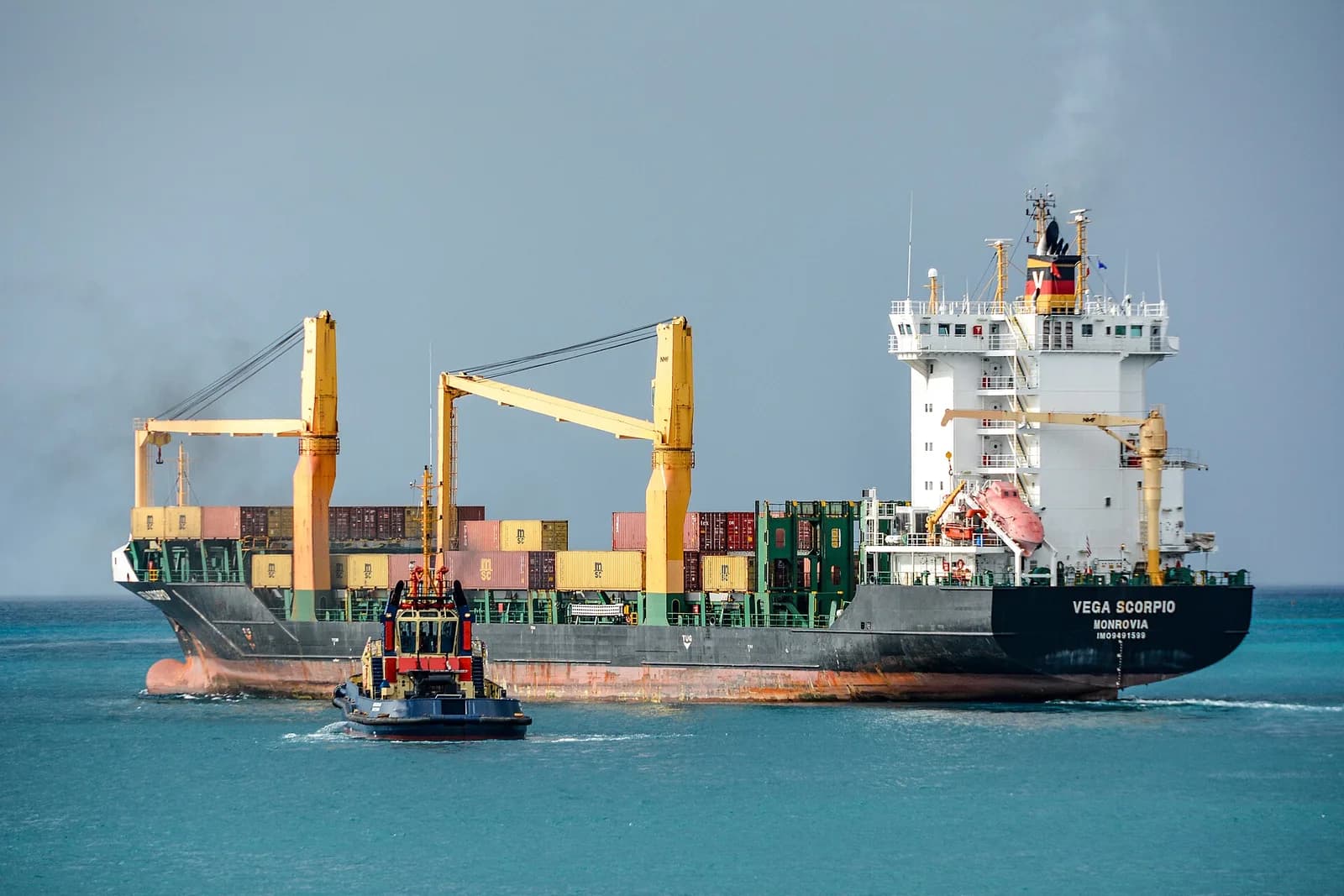
Maersk and Hapag-Lloyd will send their joint AE15 Asia to Mediterranean service back through the Suez Canal, the first Gemini Cooperation loop to give up the Cape of Good Hope detour since Houthi attacks pushed the partners' ships around Africa in November 2023. The switch, announced on July 6 and, begins with a single vessel: the 19,000 TEU, Danish-flagged Majestic Maersk, a Triple-E delivered in 2013, which is expected at the canal around July 24.
Equity markets treated the news as a warning rather than a relief. Maersk shares were down 6.6 percent by 11:47 GMT on July 6 and Hapag-Lloyd fell 3.8 percent, according to Reuters. The canal carried roughly 10 percent of global seaborne trade before the attacks, and nearly three years of Cape diversions have quietly absorbed a large slice of the container fleet. A durable return would hand that capacity back to a market that may not want it.
One ship, fully reversible
The restored rotation runs Qingdao, Kwangyang, Ningbo, Tanjung Pelepas, Port Said, Damietta, Colombo and Singapore, per Maersk's customer advisory. Both carriers describe the move as gradual and conditional, with an explicit option to revert to the Cape if security deteriorates, and no other Gemini service is yet slated to follow. The caution is earned. Maersk's ME11 service resumed Suez transits under naval escort in mid-February 2026, only for ME11 and MECL to be suspended again earlier this year; with accounts dating that suspension variously to February or March.
Seen against that history, AE15 looks less like a homecoming than a live security test with one ship as the probe. The structure is deliberately reversible: a single loop, a named first vessel and a schedule that can be pulled back at the first incident. Within days the test widened at the edges. A July 9 Maersk advisory set out structural changes to the MECL network, and further Suez routings followed, among them a Middle East to US service and the WAF6 loop.
Why the shares fell
Shorter transits, better schedule reliability and lower fuel burn all favor the carriers' cost lines. Investors looked past them to the capacity math. Jyske Bank analyst Haider Anjum told Reuters the AE15 switch was "the first step that will pave the way for a full return," which he sees as possible by the end of 2026. The timing matters because a heavy newbuild delivery wave arrives in 2027 and 2028. Tonnage released from the Cape detour would land on the market just as those ships do, pressuring rates and earnings across the sector.
Egypt raises the price of the homecoming
The Suez Canal Authority is not waiting to see whether its customers return before repricing the passage. Surcharges rose effective July 15 under a schedule announced in early June, according to industry reports: laden crude and product tankers climb from 25 to 37 percent, ballast tankers from 15 to 27 percent, dry bulk from 10 to 22 percent, LNG carriers from 7 to 19 percent, LPG and chemical carriers to 32 percent, and container ships pay 12 percent, with passenger vessels exempt.
The timing is striking. In 2025 the authority ran the opposite play, a 15 percent toll reduction for large boxships that drew 784 vessels and about 170 million dollars in revenue, yet February 2026 volumes still sat about 50 percent below their pre-crisis peak. CMA CGM has been the earliest large returnee, logging 104 Suez transits carrying 12.5 million tons between January and May 2026, with the 220,553 dwt CMA CGM Vendome making the line's first southbound passage on June 9. The scale of what Egypt lost is visible in Maersk's own history: 1,158 transits and 127 million tons of cargo through the canal in 2023. Raising surcharges at the precise moment lost customers are testing the water amounts to a bet that security, not price, decides the routing.
What to watch
The first signal is the Majestic Maersk herself, expected at the canal around July 24. A clean transit validates the test; an incident anywhere near the corridor likely freezes it, and the reversion clause exists to be used. The second is sequencing. Gemini moving one loop is a probe. MSC and the Ocean Alliance following would turn a trickle of released tonnage into a flood, and that flood would arrive against the 2027 and 2028 orderbook just as tariff-driven front-loading fades from demand. The equity market has already voted on what that combination means. The next vote belongs to the ships.
Cover image: kees torn, CC BY-SA 2.0, via Wikimedia Commons.
Cover image: Gordon Leggett, CC BY-SA 4.0, via Wikimedia Commons.

As Editor in Chief of The Maritime, I lead content development, interviews, and digital storytelling across our multimedia maritime platform. With over 10 years of experience in the maritime industry, I create and publish in-depth stories and video features that highlight key players, emerging trends, and operational realities across global shipping. Before launching The Maritime, I worked as a Vessel Operator at Imza Marine A.S., gaining hands-on commercial shipping and voyage operations experience. I also served as Marketing Communications Specialist at Gimas Ship Supply & Services, where I managed corporate communication, digital strategy, and industry outreach for shipowners and maritime clients. I hold a Master’s degree in Maritime Transportation Management from Istanbul Technical University and a Master’s degree in Publishing from Marmara University. My work is driven by the belief that the maritime world deserves strong, informed, and accessible media representation. I am committed to sharing the stories of maritime professionals and contributing to the sector’s visibility, knowledge exchange, and future development.