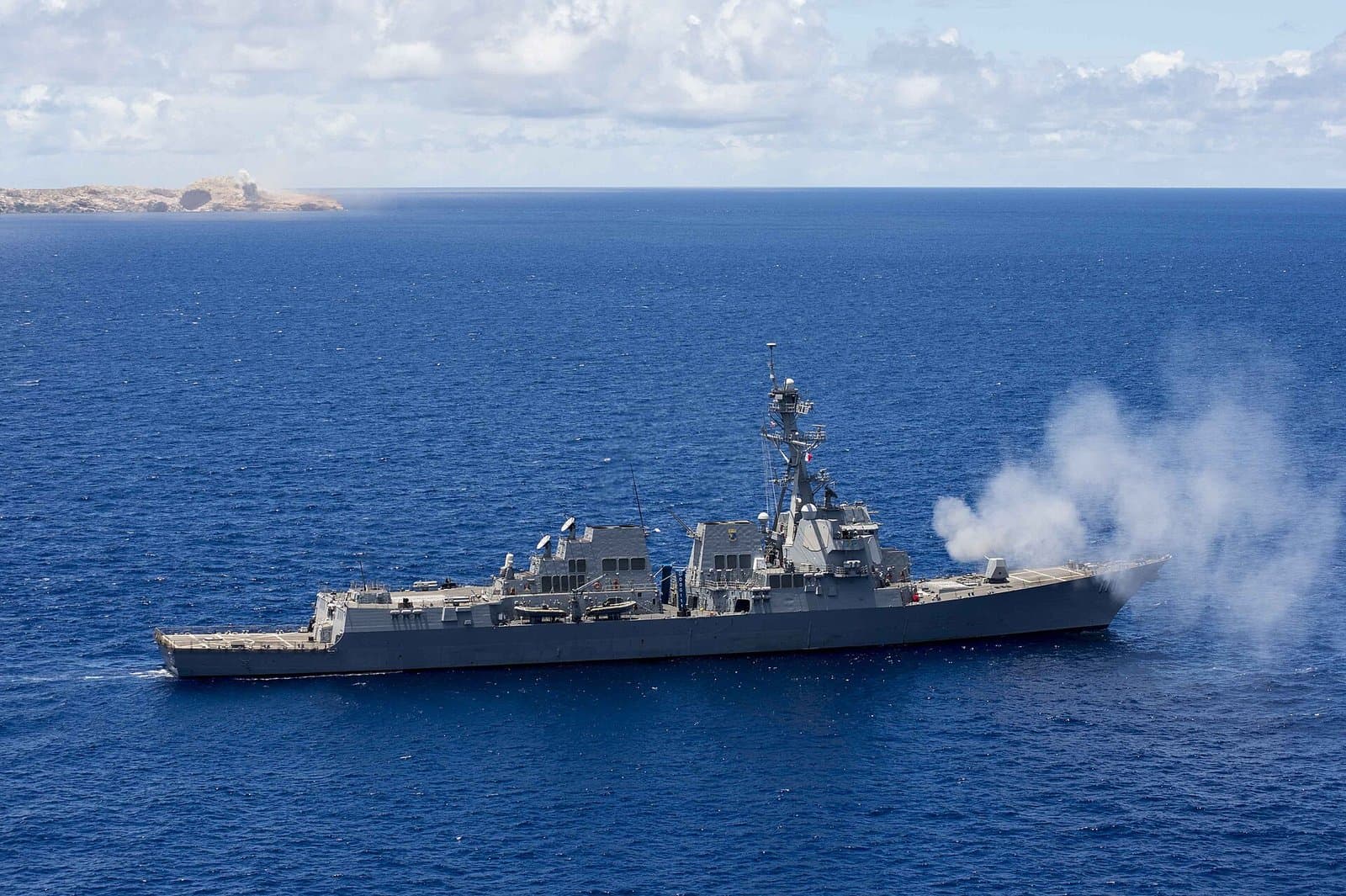
The United States Navy fired on a merchant ship for the first time in the Hormuz war on April 19. After a six-hour warning, the destroyer USS Spruance put 5-inch rounds into the engine room of the Touska, an Iranian-flagged cargo vessel of roughly 270 metres that was making 17 knots toward Bandar Abbas, disabling it in the North Arabian Sea. Marines of the 31st Marine Expeditionary Unit then rappelled from helicopters flying from the amphibious assault ship USS Tripoli and seized the ship, Stars and Stripes reported.
The boarding closed out the first week of the American blockade of Iran's ports, a week in which Iran declared the strait open, shut it again a day later, and fired on a tanker that carried Iran's own clearance. Two cordons now overlap at the mouth of the Gulf: an American one around Iranian trade, and an Iranian one around nearly everyone else's.
The cordon goes up
The blockade took effect at 10:00 EDT on April 13, mounted by more than 10,000 sailors, Marines and airmen with over a dozen warships and dozens of aircraft, among them the Spruance, the littoral combat ship USS Canberra, the Tripoli with the 31st MEU embarked, and P-8 maritime patrol aircraft. Central Command said the cordon would apply to ships of any nation using Iranian ports and coastal waters, without exception. No vessel broke through in the first 24 hours; ten had turned around by April 15, and 13 interceptions were logged on April 16, with Indo-Pacific Command authorized to pursue ships that had sailed for Iran before the start date.
More than 10,000 U.S. Sailors, Marines, and Airmen along with over a dozen warships and dozens of aircraft are executing the mission to blockade ships entering and departing Iranian ports...
@CENTCOM April 2026
The line is not airtight. BBC Verify tracked four Iran-linked ships crossing on April 14, and industry reports on April 17 indicated that eight Iranian vessels had slipped westward past the cordon, at least one of them reaching Bandar Abbas. Cumulative interceptions stood at 23 by April 18, according to the open-source record of the operation.
Open for a day, closed again
Inside the strait, the week whipsawed. On April 17, Foreign Minister Araghchi declared the waterway fully open for the duration of the Lebanon ceasefire, and more than a dozen ships transited as oil prices eased. On April 18, Iran reversed course and declared the strait closed once more in response to the blockade, with the IRGC warning that vessels approaching Hormuz would be treated as cooperating with the enemy, Al Jazeera reported.
Clearance protected no one
April 18 also showed what Iranian paperwork is worth under fire. IRGC gunboats fired on the India-flagged tanker Sanmar Herald, damaging its bridge windows, even though the ship held a valid IRGC transit clearance. A drone struck the French-flagged CMA CGM Everglade off Oman, damaging containers and making it the first ship under a NATO member's flag hit in the war. The Malta-flagged cruise ship Mein Schiff 4 reported an impact 150 metres from its hull and threats over VHF radio before leaving the region with five other cruise ships. No casualties were reported in the three incidents. The pattern undercuts the transit system Iran has marketed since the ceasefire failed to reopen the strait: a permit from Tehran protected the Sanmar Herald from nothing at all.
The Touska and the reaction
The Touska sails under US Treasury sanctions, and Reuters reported the ship was probably carrying dual-use equipment from China. Iran's response came within hours. The IRGC's Khatam al-Anbiya headquarters called the seizure a ceasefire violation and vowed retaliation, UN ambassador Iravani asked the United Nations to intervene, and Araghchi called the strike "proof of America's lack of seriousness in diplomacy," according to The Jerusalem Post. President Trump answered that Iran cannot blackmail the United States. Later on April 19, Iranian drones approached American warships without causing damage.
What comes next
Firing into a merchant hull and seizing the ship moves the blockade from deterrence into prize-taking, and it revives legal questions about captured merchant vessels that admiralty lawyers have not argued in earnest for decades. What becomes of the Touska, her cargo and her crew will now be watched as closely as any interception tally. The retaliation vowed by Khatam al-Anbiya could fall on blockade warships, on merchant traffic or on neither, and each option carries a different price. Watch, too, whether the evasion rate grows as Iranian operators learn the cordon's gaps, and whether a strait re-closed by Iran and physically gated by two navies leaves any corridor for the exempted flows both sides still claim to permit. A week that began with a blockade schedule ended with naval gunfire into a cargo ship's engine room. The distance between those two points took six days to cross.

As Editor in Chief of The Maritime, I lead content development, interviews, and digital storytelling across our multimedia maritime platform. With over 10 years of experience in the maritime industry, I create and publish in-depth stories and video features that highlight key players, emerging trends, and operational realities across global shipping. Before launching The Maritime, I worked as a Vessel Operator at Imza Marine A.S., gaining hands-on commercial shipping and voyage operations experience. I also served as Marketing Communications Specialist at Gimas Ship Supply & Services, where I managed corporate communication, digital strategy, and industry outreach for shipowners and maritime clients. I hold a Master’s degree in Maritime Transportation Management from Istanbul Technical University and a Master’s degree in Publishing from Marmara University. My work is driven by the belief that the maritime world deserves strong, informed, and accessible media representation. I am committed to sharing the stories of maritime professionals and contributing to the sector’s visibility, knowledge exchange, and future development.