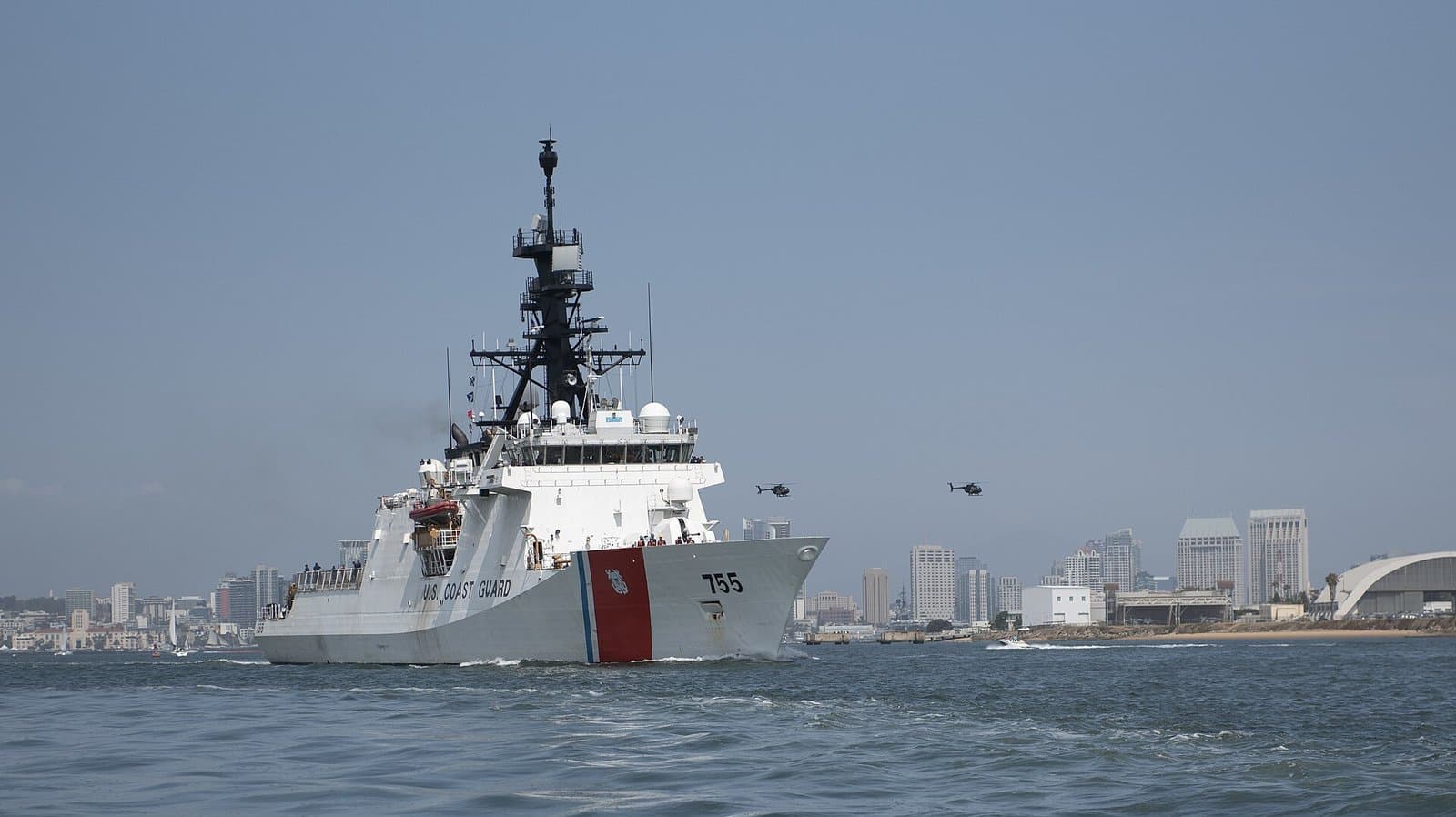
A Department of Homeland Security-led operation boarded and seized the tanker Marinera roughly 300 miles south of Iceland on January 7, according to Stars and Stripes. The force assembled for the interception was striking for a sanctions action: the Coast Guard cutter Munro, Navy SEALs and special operations forces, helicopters, and a P-8 patrol aircraft overhead, all committed against a single empty tanker in the waters between Iceland and Scotland.
The seizure moves the Venezuela campaign into new legal and geographic territory. What began as a quarantine in the Caribbean, the cordon that shut down Venezuela's oil exports the previous week, has now produced an armed interdiction of a Russian-flagged merchant ship on the high seas of the North Atlantic, with Russian naval assets in the vicinity.
A two-week run across the Atlantic
Marinera began this voyage under another name. As Bella 1, the vessel (IMO 9230880) was sanctioned in 2024 for smuggling cargo for a network linked to Hezbollah and has been tied to Iranian oil trades. US forces first intercepted her in the Caribbean on December 21 as she headed toward Venezuela to load; the crew refused a boarding, turned away, and ran the Atlantic for more than two weeks.
On January 1 the ship appeared in the Russian Maritime Register under the new name Marinera, flying the Russian flag. The reflagging looked like a wager that Washington would not board a vessel under the flag of a nuclear power. On January 7 that wager failed. The tanker was seized empty, which makes the point sharper: the cargo was never the object. The hull was. Removing a ship from the trade permanently is worth more to the campaign than confiscating any single cargo, because a dark fleet is only as large as the tonnage still willing to serve it.
Moscow protests, London assists
Russian naval assets, including a submarine, were reported in the vicinity of the interception, and Moscow protested that the seizure violated the UN Convention on the Law of the Sea. The United Kingdom provided support to the operation, including Royal Air Force surveillance. The diplomatic geometry, a US boarding of a Russian-flagged ship with British assistance while Russian units observed, is without recent precedent in commercial shipping.
Defense Secretary Pete Hegseth said the United States "continues to enforce the blockade against all dark fleet vessels illegally transporting Venezuelan oil", according to Stars and Stripes. CNN's live coverage tracked the day's rapid sequence of announcements from Washington.
The blockade of sanctioned and illicit Venezuelan oil remains in FULL EFFECT.
@PeteHegseth January 7, 2026
The net widens with M Sophia
The same day, US Southern Command announced the seizure of the tanker M Sophia (IMO 9289477) in the Caribbean, describing her as a stateless, sanctioned dark fleet motor tanker carrying about 1.8 million barrels. Her transponder had been switched off for five months, a reminder that AIS darkness, long the dark fleet's working camouflage, now functions almost as a confession. The running chronology of the quarantine shows the campaign compounding week by week: first port paralysis, then seizures at the anchorages, now pursuit across an ocean.
What to watch
Three questions now hang over the trade. First, the legal one: Moscow's UNCLOS protest will test how far a quarantine framing can stretch to cover boarding a foreign-flagged vessel in the North Atlantic, and whether other flag states follow Russia in objecting. Second, the commercial one: if a 2024 sanctions listing can end in a special-forces boarding two years later, the value of sanctioned tonnage and the appetite of any insurer or port to touch it fall further, tightening the economics of the entire shadow trade. Third, the operational one: flag-hopping and AIS manipulation, the standard toolkit that let sanctioned ships keep trading for years, visibly failed to protect Marinera. Owners of the tankers that fled Venezuelan waters in early January must now decide whether any flag, or any ocean, still offers cover.

As Editor in Chief of The Maritime, I lead content development, interviews, and digital storytelling across our multimedia maritime platform. With over 10 years of experience in the maritime industry, I create and publish in-depth stories and video features that highlight key players, emerging trends, and operational realities across global shipping. Before launching The Maritime, I worked as a Vessel Operator at Imza Marine A.S., gaining hands-on commercial shipping and voyage operations experience. I also served as Marketing Communications Specialist at Gimas Ship Supply & Services, where I managed corporate communication, digital strategy, and industry outreach for shipowners and maritime clients. I hold a Master’s degree in Maritime Transportation Management from Istanbul Technical University and a Master’s degree in Publishing from Marmara University. My work is driven by the belief that the maritime world deserves strong, informed, and accessible media representation. I am committed to sharing the stories of maritime professionals and contributing to the sector’s visibility, knowledge exchange, and future development.