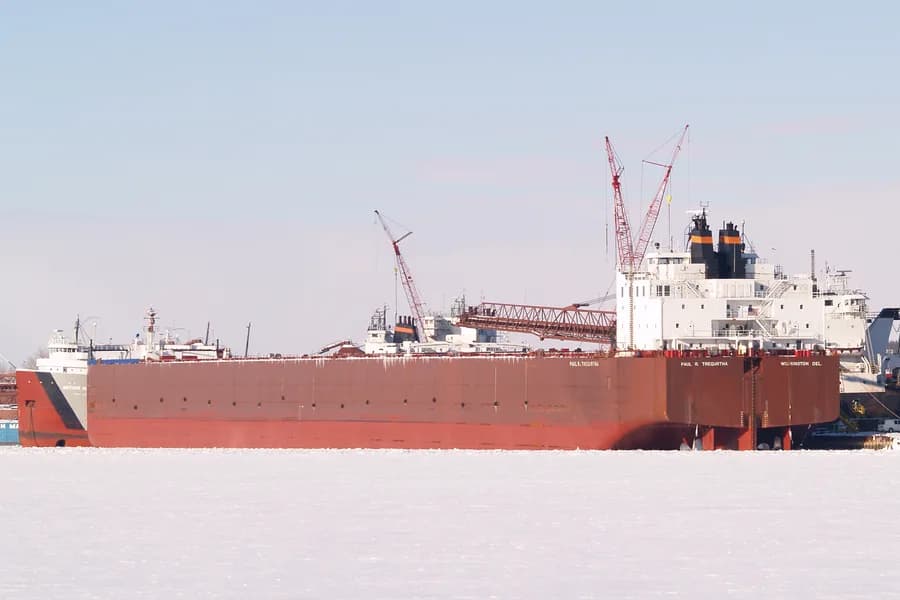
Built by American Ship Building Company in 1981
Technical Specifications
Overview
MV Paul R. Tregurtha is a Great Lakes-based bulk carrier freighter. She is the current Queen of the Lakes, an unofficial but widely recognized title given to the longest vessel active on the Great Lakes. Launched as MV William J. De Lancey, she was the last of the thirteen "thousand footers" to enter service on the Great Lakes, and was also the last Great Lakes vessel built at the American Ship Building Company yard in Lorain, Ohio. The MV Paul R. Tregurtha is the current flagship for the Interlake Steamship Company.
Live Tracking
Most time stopped at Duluth: 3 d across 4 stays.
Derived from the AIS track: runs of near-zero speed (anchored, moored or drifting) snapped to the nearest port. Builds up as we observe the vessel.
Resolved from the live AIS destination. Distance is the real sea route (around land and through canals). “Off the port” is steaming time only; “likely alongside” adds the wait this port has actually kept comparable ships for. The queue is a typical case, not a promise — berth waits vary far more than they average. A destination is the crew’s stated intent, not a confirmed fixture.
Intelligence
A quick estimate: the median $/dwt of 2 similar-size, similar-age ships sold in the last 24 months, not re-timed to today's market. The full valuation blends several models over recent sales adjusted for size, age and market moves, so its consensus value can differ from this figure. Indicative, not a certified valuation.
See the full valuation consensusThis ship has no verified emissions report. We estimate a band C from its segment, size and age (62% confidence).
Estimate, not a reported figure. Within one band 94% of the time on reported peers.
AIS-derived from our live feed.
Compliance
On 18 August 2022, the bulk carrier "PAUL R. TREGURTHA" reported sustaining a port main engine failure in Lake Erie off Kingsville, ON. The vessel proceeded to the nearest anchorage for repairs.
On 04 June 2006, at 1630, the bulk carrier "PAUL R. TREGURTHA" rept'dly caused wake damage. V/L met & passed 2 V/L's in the St.Marys River, near Pt. Aux Pins. Channel water was displaced causing minor damage to dock & P/C .
Recorded marine occurrences naming this vessel.
Operational Status
Making way at sea speed on its latest broadcast.
Read from the single most-recent AIS broadcast we hold for this hull. We keep no position history, so this is a point-in-time posture, not a dwell inference. Derived in-house from our own AIS feed; weight it by the broadcast age above.
Arrivals, time in port and the load/discharge inferred from the draught change, detected from AIS track history. An open call means the vessel is still in port (no departure observed yet).
Method: each call is a run of fixes inside a port’s geofence confirmed by a stop (or an AIS gap); load/discharge is the sign of the draught delta over the call. Indicative: arrivals before our AIS history began read from the first observation.
Time-in-port summed by port from the AIS-detected port-call history: the ports this vessel has spent the most time at, longest first.
Based on 22 completed calls observed since . Open calls (no departure yet) are excluded. The distribution sharpens as AIS history accrues.
Composite Risk
Multiple adverse factors, or a hard ship-specific signal, lift this hull above the fleet norm.
A coverage-weighted blend of the single component we could read for this hull; the weights renormalise over only the components present, so a thin read is never inflated and a hull is never credited a “safe 0” for a signal it has no row for. This headline is flagged low-confidence (a thin or structural-only read) and should not be treated as a verdict. Higher means riskier. Derived in-house from government-open port-State-control, flag, sanctions and our own vessel data; weight it by the coverage above.
Estimated
Bulker · summer draught 8.1 m · 66.3 t per cm immersion
Estimate only: modelled from deadweight (deadweight regression) using a first-principles hydrostatic model, not measured hydrostatic tables. The design draught it is anchored to is unreliable across the fleet.
density DWT/GT=1.90 is consistent with declared bulker
Declared type is consistent with the class implied by the vessel’s size signals. Inferred via our shared size-based classifier.
Commercial
Price it in the Route Planner between any two commercial ports: ballast and laden legs, two fuels at live bunker prices, port and canal costs, the weather on the way, and the TCE set against the market.
Typical Panamax/Kamsarmax speed and burn. Replace them with the ship's own figures in the planner.

Visual Archive
Explore More