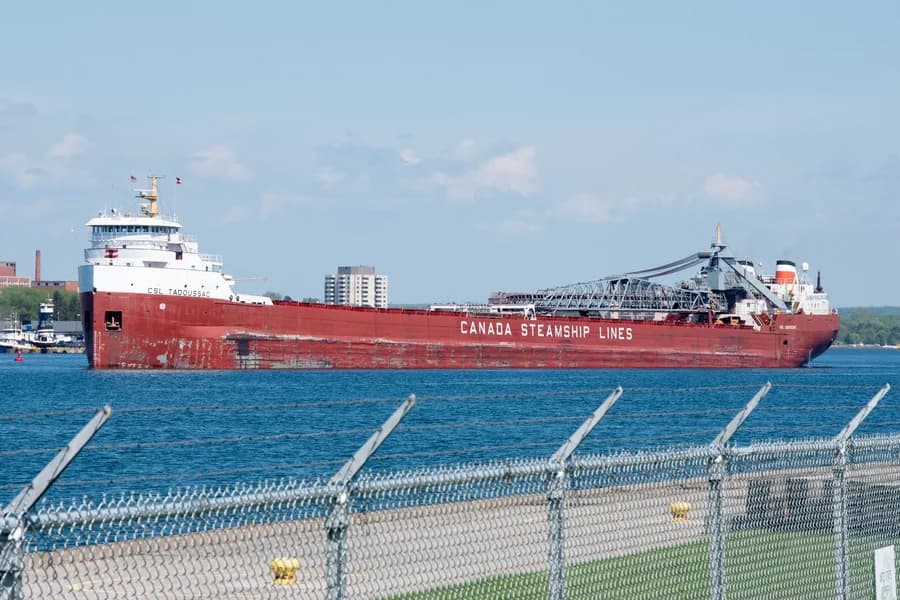
Built by Collingwood Shipbuilding in 1969
Technical Specifications
Overview
CSL Tadoussac is a lake freighter currently operated by Canada Steamship Lines (CSL) on the Great Lakes. She was launched in 1969. Initially named Tadoussac, following her refit in 2001, she was renamed CSL Tadoussac She was the last freighter built for CSL in the traditional two superstructure design, which puts her bridge up in the ship's bow. The vessel primarily transports iron ore and coal.
Live Tracking
Most time stopped at Clarkson: 12 d across 23 stays.
Derived from the AIS track: runs of near-zero speed (anchored, moored or drifting) snapped to the nearest port. Builds up as we observe the vessel.
Intelligence
Compliance
On 23 September 2025, the bulk carrier "CSL TADOUSSAC", while under the conduct of a pilot, reported an emergency anchoring due to a total loss of propulsion at the exit of the St. Lawrence Seaway off St. Lambert, QC. The crew re-started the engine and addressed a cooling issue while resuming the downbound voyage to Québec, QC.
On 20 November 2023, the bulk carrier "CSL TADOUSSAC" reported having sustained a small ingress of water due to a crack found in one of its port ballast tanks while secured in Rouge River, MI, USA. The vessel proceeded to Sarnia, ON for repairs.
On 08 August 2020, the bulk carrier "CSL TADOUSSAC" allided with the abutment for old Bridge 10 in the Welland Canal, ON. The vessel did not sustain damage.
On 10 June 2020, the bulk carrier "CSL TADOUSSAC", under the conduct of a pilot, struck the dock while berthing in Québec, QC. The vessel sustained major damage.
On 11 May 2020, the bulk carrier "CSL TADOUSSAC" reported a crack in one of its ballast tanks off Pelee Island, ON. The vessel continued its voyage.
On 24 October 2019, the bulk carrier "CSL TADOUSSAC" reported a crack in one of its fuel tanks while the vessel was berthed in Sarnia, ON. Permanent repairs were carried out.
On 16 June 2019, the bulk carrier "CSL TADOUSSAC" ran aground when entering Nanticoke Harbour, ON. The vessel freed itself later with the assistance of a tug. There were no injuries, damage, or pollution reported.
On 01 May 2019, the bulk carrier "CSL TADOUSSAC" reported having touched bottom while leaving Nanticoke, ON. The vessel berthed in the Welland Canal off St. Catharines, ON, for inspection. No pollution or injuries were reported.
Recorded marine occurrences naming this vessel.
Operational Status
Stopped, anchored or moored on its latest broadcast: parked, not necessarily withdrawn.
Read from the single most-recent AIS broadcast we hold for this hull. We keep no position history, so this is a point-in-time posture, not a dwell inference. Derived in-house from our own AIS feed; weight it by the broadcast age above.
Arrivals, time in port and the load/discharge inferred from the draught change, detected from AIS track history. An open call means the vessel is still in port (no departure observed yet).
Method: each call is a run of fixes inside a port’s geofence confirmed by a stop (or an AIS gap); load/discharge is the sign of the draught delta over the call. Indicative: arrivals before our AIS history began read from the first observation.
Time-in-port summed by port from the AIS-detected port-call history: the ports this vessel has spent the most time at, longest first.
Based on 51 completed calls observed since . Open calls (no departure yet) are excluded. The distribution sharpens as AIS history accrues.
Composite Risk
Multiple adverse factors, or a hard ship-specific signal, lift this hull above the fleet norm.
A coverage-weighted blend of the 2 components we could read for this hull; the weights renormalise over only the components present, so a thin read is never inflated and a hull is never credited a “safe 0” for a signal it has no row for. This headline is flagged low-confidence (a thin or structural-only read) and should not be treated as a verdict. Higher means riskier. Derived in-house from government-open port-State-control, flag, sanctions and our own vessel data; weight it by the coverage above.
Estimated
Bulker · summer draught 7.8 m · 46.5 t per cm immersion
Estimate only: modelled from deadweight (hull geometry) using a first-principles hydrostatic model, not measured hydrostatic tables. The design draught it is anchored to is unreliable across the fleet.
density DWT/GT=1.46 is consistent with declared bulker
Declared type is consistent with the class implied by the vessel’s size signals. Inferred via our shared size-based classifier.
Commercial
Price it in the Route Planner between any two commercial ports: ballast and laden legs, two fuels at live bunker prices, port and canal costs, the weather on the way, and the TCE set against the market.
Typical Handysize speed and burn. Replace them with the ship's own figures in the planner.

Visual Archive
Explore More