Technical Specifications
Overview
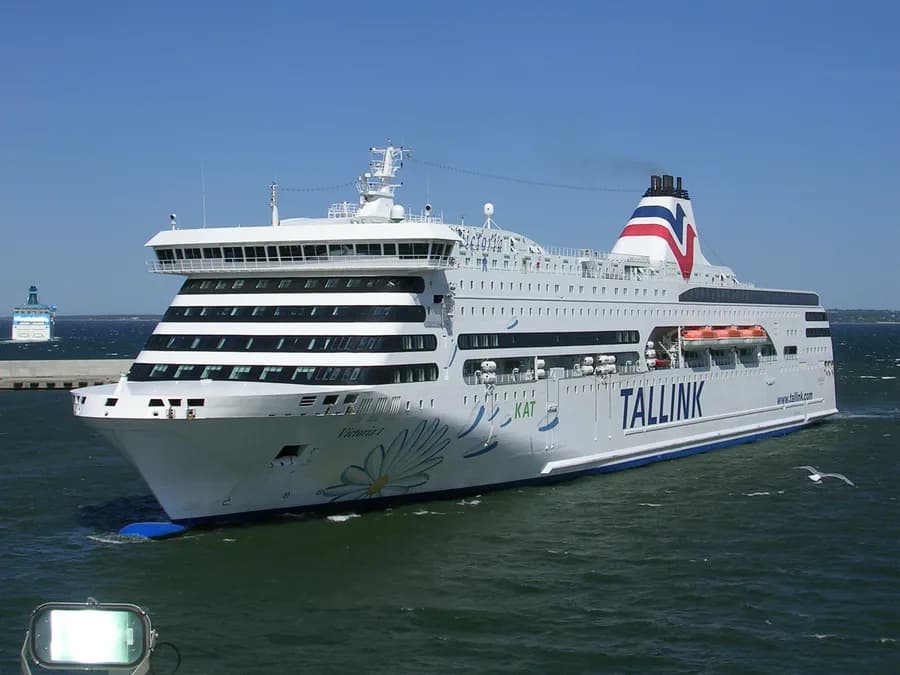
MS Victoria I is a cruiseferry owned by AS Tallink Grupp. It was chartered by the UK Government to provide temporary accommodation to those fleeing the 2022 Russian invasion of Ukraine. The vessel was docked in the Port of Leith, in Edinburgh, Scotland. The ship, which was chartered until July 2023, had been providing people with accommodation until they secure somewhere to stay longer term. It took in its first Ukrainian residents in July 2022. On 1 August 2023 Victoria I arrived back in her home port at Tallinn and currently the vessel on service between Tallinn and Helsinki starting from 12 October. The Victoria I was formerly on a route connecting Stockholm, Sweden to Tallinn, Estonia via Mariehamn, Finland. She was built in 2004 by Aker Finnyards, Rauma. Although the ship's official name is Victoria I, she is often referred to as Victoria, without the number. This is also the name displayed on top of her superstructure, whereas the name is written in full form on the hull. Between 18 and 20 November 2005, the Victoria I made two one-day cruises from Helsinki to Tallinn, the latter of which was a re-election campaign cruise for the Finnish president Tarja Halonen. The use of an Estonian-flagged ship by the president provoked protests from the Finnish Seamen's Union.
Live Tracking
Most time stopped at Tallinn — 15 d across 42 stays.
Derived from the AIS track — runs of near-zero speed (anchored, moored or drifting) snapped to the nearest port. Builds up as we observe the vessel.
Intelligence
Verified reported figure. Band is peer-relative, not official IMO CII.
Operational Status
Making way at sea speed on its latest broadcast.
Read from the single most-recent AIS broadcast we hold for this hull — we keep no position history, so this is a point-in-time posture, not a dwell inference. Derived in-house from our own AIS feed; weight it by the broadcast age above.
Arrivals, time in port and the load/discharge inferred from the draught change — detected from AIS track history. An open call means the vessel is still in port (no departure observed yet).
Method: each call is a run of fixes inside a port’s geofence confirmed by a stop (or an AIS gap); load/discharge is the sign of the draught delta over the call. Indicative — arrivals before our AIS history began read from the first observation.
Time-in-port summed by port from the AIS-detected port-call history — the ports this vessel has spent the most time at, longest first.
Based on 41 completed calls observed since — open calls (no departure yet) are excluded. The distribution sharpens as AIS history accrues.
Composite Risk
Multiple adverse factors, or a hard ship-specific signal, lift this hull above the fleet norm.
A coverage-weighted blend of the single component we could read for this hull — the weights renormalise over only the components present, so a thin read is never inflated and a hull is never credited a “safe 0” for a signal it has no row for. This headline is flagged low-confidence (a thin or structural-only read) and should not be treated as a verdict. Higher means riskier. Derived in-house from government-open port-State-control, flag, sanctions and our own vessel data; weight it by the coverage above.

Visual Archive
Explore More