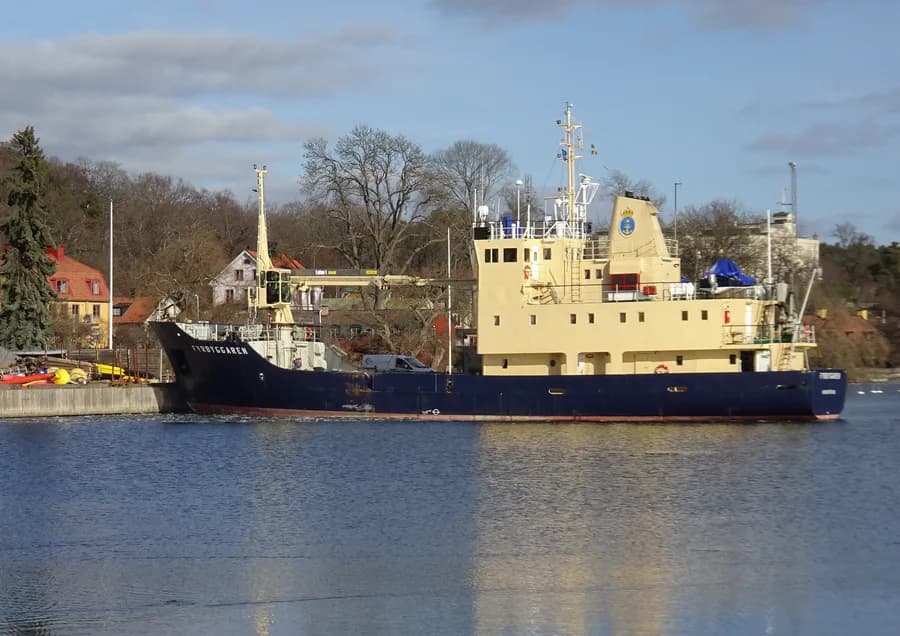
- IMO
- 7504213
- MMSI
- 265289000
- Call Sign
- SDJP
Technical Specifications
Key Figures
Live Tracking
Current Position
Where it waited most
Most time stopped at Longyearbyen — 20 h across 1 stay.
- 1Longyearbyen20 h
- 2Offshore 78.25,13.8512 h
- 3Offshore 79.59,18.4310 h
- 4Offshore 78.99,25.7510 h
- 5Offshore 79.09,26.745 h
- 6Offshore 78.89,20.522 h
- 7Offshore 79.80,11.852 h
Derived from the AIS track — runs of near-zero speed (anchored, moored or drifting) snapped to the nearest port. Builds up as we observe the vessel.
Intelligence
Risk & Sustainability
- Longyearbyen0.9 dJun 25, 2026
- Longyearbyen0.6 dJun 18, 2026
AIS-derived from our live feed.
Operational Status
Activity
Stopped, anchored or moored on its latest broadcast — parked, not necessarily withdrawn.
Read from the single most-recent AIS broadcast we hold for this hull — we keep no position history, so this is a point-in-time posture, not a dwell inference. Derived in-house from our own AIS feed; weight it by the broadcast age above.
Port calls
1 recent · AIS-detectedArrivals, time in port and the load/discharge inferred from the draught change — detected from AIS track history. An open call means the vessel is still in port (no departure observed yet).
- no cargo change→ · 21 h in port· draught 4.0→4.0 m
Method: each call is a run of fixes inside a port’s geofence confirmed by a stop (or an AIS gap); load/discharge is the sign of the draught delta over the call. Indicative — arrivals before our AIS history began read from the first observation.
Where it waits
1 port · 21 h totalTime-in-port summed by port from the AIS-detected port-call history — the ports this vessel has spent the most time at, longest first.
- Longyearbyen· Svalbard and Jan Mayen21 h1 call · 21 h avg
Based on 1 completed call observed since — open calls (no departure yet) are excluded. The distribution sharpens as AIS history accrues.
Composite Risk
Risk Score
Multiple adverse factors, or a hard ship-specific signal, lift this hull above the fleet norm.
A coverage-weighted blend of the 2 components we could read for this hull — the weights renormalise over only the components present, so a thin read is never inflated and a hull is never credited a “safe 0” for a signal it has no row for. This headline is flagged low-confidence (a thin or structural-only read) and should not be treated as a verdict. Higher means riskier. Derived in-house from government-open port-State-control, flag, sanctions and our own vessel data; weight it by the coverage above.
Commercial
Voyage Estimate

Visual Archive
Gallery
Explore More
Similar Vessels
Community
Vessel Comments