Technical Specifications
Overview
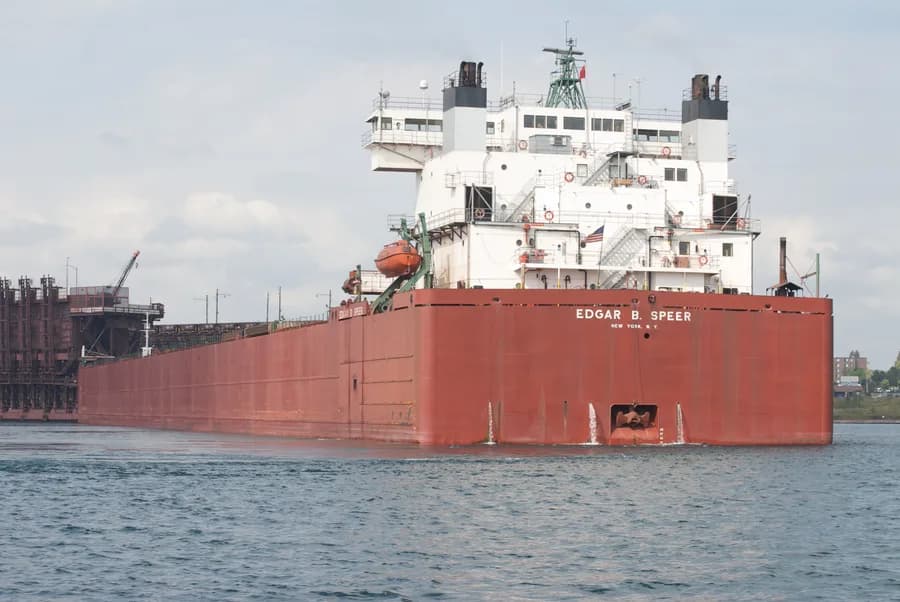
MV Edgar B. Speer is a very large diesel-powered lake freighter owned and operated by Great Lakes Fleet, Inc, a subsidiary of Canadian National Railway. This vessel was built in 1980 in two halves by American Ship Building Company, in Lorain and Toledo, Ohio, with the two halves being joined in Lorain. The ship is 1,004 feet (306 m) long and 105 feet (32 m) at the beam. It has a carrying capacity of 2,105,527 cubic feet (59,621.9 m3), has a 52-foot (16 m) unloading shuttle boom and is capable of unloading 10,00 NT/hr. The maximum load that the Edgar B. Speer, is cable of carrying is about 74,100 tons. The ship has 20 hatches which are 28 by 11 feet (8.5 by 3.4 m), which open into 5 cargo holds. Unlike her sister ship Edwin H. Gott, Edgar B. Speer has retained her shuttle boom.This unique unloading system restricts her to transporting iron ore to Conneaut, Ohio and Gary, Indiana. As of 2025 the only other vessel in service with a shuttle boom configuration is the Stewart J. Cort.
Intelligence
A quick estimate: the median $/dwt of 2 similar-size, similar-age ships sold in the last 24 months, not re-timed to today's market. The full valuation blends several models over recent sales adjusted for size, age and market moves, so its consensus value can differ from this figure. Indicative, not a certified valuation.
See the full valuation consensusThis ship has no verified emissions report. We estimate a band C from its segment, size and age (60% confidence).
Estimate, not a reported figure. Within one band 94% of the time on reported peers.
Composite Risk
Multiple adverse factors, or a hard ship-specific signal, lift this hull above the fleet norm.
A coverage-weighted blend of the single component we could read for this hull; the weights renormalise over only the components present, so a thin read is never inflated and a hull is never credited a “safe 0” for a signal it has no row for. This headline is flagged low-confidence (a thin or structural-only read) and should not be treated as a verdict. Higher means riskier. Derived in-house from government-open port-State-control, flag, sanctions and our own vessel data; weight it by the coverage above.
Estimated
Bulker · summer draught 8.7 m · 70.1 t per cm immersion
Estimate only: modelled from deadweight (deadweight regression) using a first-principles hydrostatic model, not measured hydrostatic tables. The design draught it is anchored to is unreliable across the fleet.
density DWT/GT=2.18 is consistent with declared bulker
Declared type is consistent with the class implied by the vessel’s size signals. Inferred via our shared size-based classifier.
Commercial
Price it in the Route Planner between any two commercial ports: ballast and laden legs, two fuels at live bunker prices, port and canal costs, the weather on the way, and the TCE set against the market.
Typical Panamax/Kamsarmax speed and burn. Replace them with the ship's own figures in the planner.

Visual Archive
Explore More